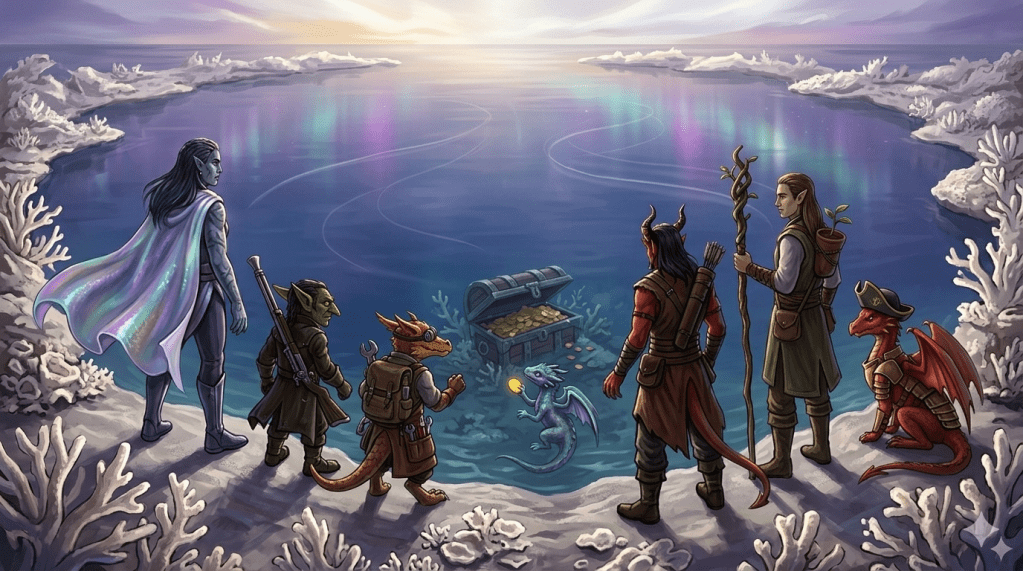
The song settled over them, gentle, calling them onward. The lagoon was very still — the kind of still that water gets when something inside it wants you to stay. So Kaymos sent Fizz.
The little drake skimmed the surface, head low, and was suddenly down, nose-first into the shallows. He came up with a single gold coin in his fore-claws.
There was, the Watch could now see, an entire chest of them. Iron-banded, half-buried at the lagoon’s brim, lid waiting to be sprung open. Fizz had been able to see the chest from the surface. That was the part that should have given them pause. That was the part that did not.
The coin was a Waterdeep gold dragon — clean, well-struck, the kind of coin that does not appear at the bottom of a lagoon in the middle of the Silver Void unless somebody has gone to a great deal of trouble to put it there.
The chest caught the light. The chest caught Kaymos.
The Three Wrecks
The chest was not the treasure the lagoon had to offer. There was another coin past it. Another past that. A trinkets and purses half-fused to the petrified reef or hidden amongst the wrecks in the deeper blue. The lagoon was carpeted in the things, salt-dulled and unmistakable, and they lay shallow enough that you could almost reach them.
Kaymos went in after one. It was just past his fingertips. He went in after the next. It was the same. Pea swam with him — there was no point talking him out of it — and the two of them got further out, and deeper, with every treasure just a little deeper a little further from shore.
There were three wrecks on the floor of the lagoon, fanned out at increasing depth, and the Watch searched them in the order the water allowed.
The first was a fey pleasure barge. Gilt-trimmed, mother-of-pearl inlaid, hull split. Kaymos reached into the chest itself and the first thing his fingers closed on was not coin but *wood* — a small ash-wood wand, a tiny smile carved at the tip, the wand-tip glowing faint pink-gold in his palm. He put it through his belt and kept after the gold.
The second was a Calishite war galley — stern broken, oars splayed, painted prow-eyes still staring forward. Tink went down through the wreck and came up with two small wonders: a brass pocket-watch on a frayed silk ribbon, hands moving steadily and wrong in a way he could not at first place (it was the time on Toril, a world that no longer exists), and a brass Salutator on an ornate stand — a tiny jointed hand that, wound once, bowed and doffed an imaginary hat. He laughed underwater. A single bubble.
Lindon, who had hung back, climbed aboard the war galley and resurfaced with a fey-oak quarterstaff, leather grip wrapped tight. The grip was warm. It was the only warm thing in any of the wrecks.
The third was an elven longship. Pale wood. Swan-neck keel. Tink had only just put his hand on the rail when the lagoon stopped allowing him to look.
The Wave
Pea said it quietly, the way Pea says things: perhaps they had come far enough.
Pea and Kaymos turned to swim back. They did not get there.
The wave came out of the edge. Not where any of them would have looked for one. It rose up out of the rim they had been swimming toward — and rolled inward, away from safety, into the lagoon. It took them inward and pushed them down and did not let go.
The pleasure barge sagged. The Calishite galley listed harder. The elven longship, with Tink’s hand still on the rail, settled — into a deeper part of the lagoon that until that moment had not existed. Pea and Kaymos were pushed down through the deep blue and joining Tink and Lindon pinned by the currents to the bottom.
The light above was cutoff as upturned wrecks pile atop them.
Tendrils
Trapped beneath the upturned hull of the Elven longship they watched as a silvery bubble of air found a small gap in the hull and escaped before they could take half a gasp.
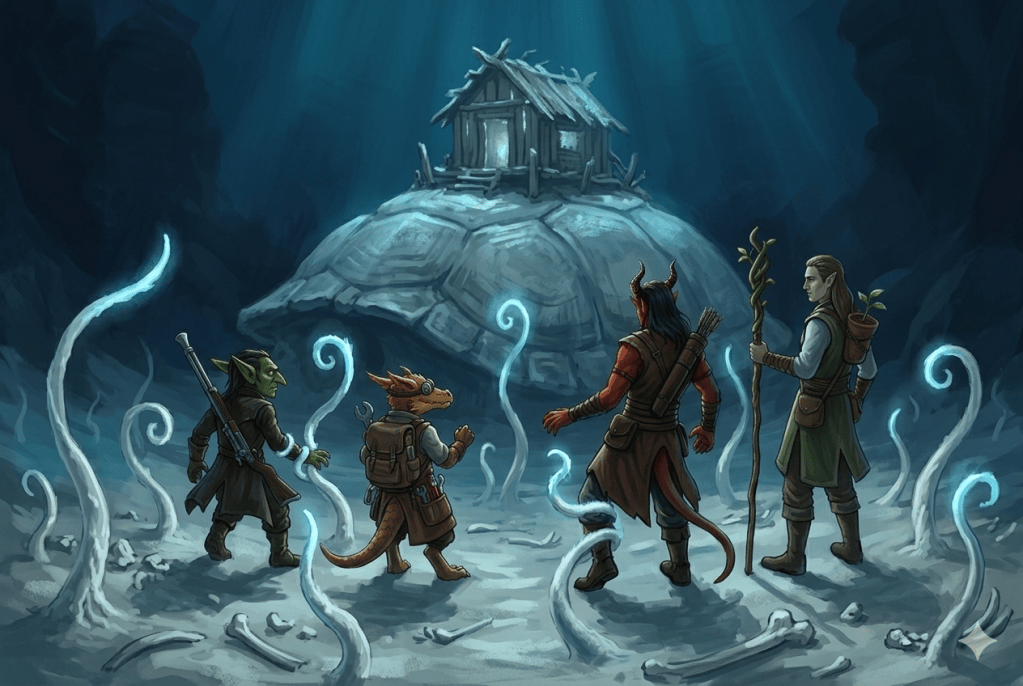
The second thing they saw — and it took them longer than they would have liked — was that the silt around them was moving.
There were tendrils in it. Not weeds. Not roots. The colour of the coldest water there is — milk-white, pale-blue at the tip — leaving frost where they touched warm skin. They came up out of the sediment in slow grasping curls, the way ice grows when no one is looking, and what they wanted, very clearly, was to pull the Watch further down — through the silt, into the dark below the dark.
The Watch kicked through. Not all cleanly. The tendrils receded as they swam onwards searching for a way through the maze of coral and upturned hulls, but not before each of them had felt, very briefly, the cold lagoon trying to claim them.
Solitude
Kaymos found the first air pocket.
He came up into it alone — a small bell of trapped air under a coral overhang. He breathed. Through the water beyond he could see Pea and Tink, kicking for something they had not found.
They were as low on air as he was. They did not know about the pocket. The pocket was small. If he called out, it would not be his pocket any more.
He did not call.
He breathed. He went back under. He did not say where he had been. Pea and Tink, when they surfaced much later into something else, looked at each other with the kind of look that does not need words.
Turtle Shell
Ontop of the dome of a giant turtle shell, someone had once built a small hut. Driftwood. Rope. Lichen-light glowing faintly within.
Tink went in. He had been hunting trapped air the whole descent, and a house was the best chance he had. He turned things over — a low bed of woven kelp, a coral hearth, bundles of dried things in the rafters that the water had not, somehow, made wet. A row of small jars on a shelf, labelled in a hand that Lindon, drifting at the doorway, half-recognised — and then thought better of recognising.
It had been a sea-hag’s. A hand that knew the same craft Nana Fogbreath knew.
Tink picked up a corroded copper pot from the hearth and flipped it lip-up, hoping. The pot gave up a single small bubble and was empty.
He took only one thing — a small corked bottle labelled for the song — and drank it on the way out.
Kelp Forest
Between the bowl and the centre was the kelp. Old, tall, the kind of dark green-black that does not let light through. The currents inside it pulled sideways. It did not want them through.
Tink had little breath left in him and Pea was losing colour. Kaymos, who had spent his hidden pocket on himself, was for the first time running out faster than the others.
Lindon stopped.
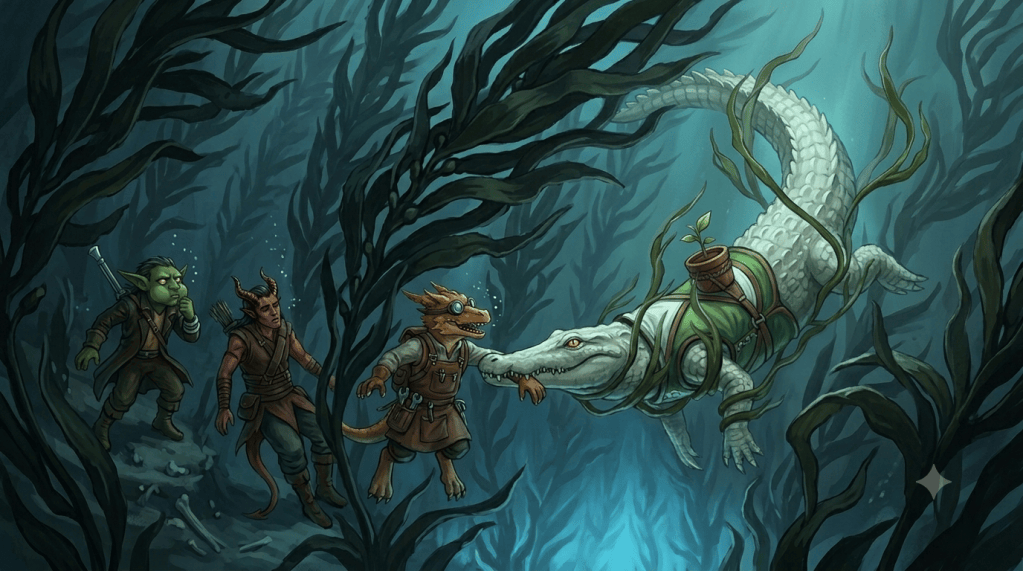
Lindon stopped, and turned, and changed.
It was the first time he had ever found a shape he could use. He had been a druid for a long time, in the quiet, patient half-elf way that druids are druids. He had been a deer in a field. He had not, until that moment, been something the world needed him to be.
The thing in the kelp was no longer Lindon. It was longer than him, and lower in the water, and its jaw was long and pale, and its eyes were a crocodile’s eyes. It moved through the kelp the way the kelp wanted to be moved through.
It took Tink’s wrist in its mouth, very gently, and pulled him through. It came back for Pea. It came back for Kaymos. None of them refused.
Whirlpool
They came out of the kelp into the centre.
The blue glow was not in a crystal. It was the splinter itself — blue-black, head-sized, suspended on churning waves of water that the song had been singing into being all along.
And the song, here, had singers.
Three of them rose from the corpses scattered across the lagoon floor, others mouthed the words where they lay, as the Watch arrived. A tall one — the choir master — and two on either side. They opened their mouths, and the song the Watch had been swimming through this whole time had a source.
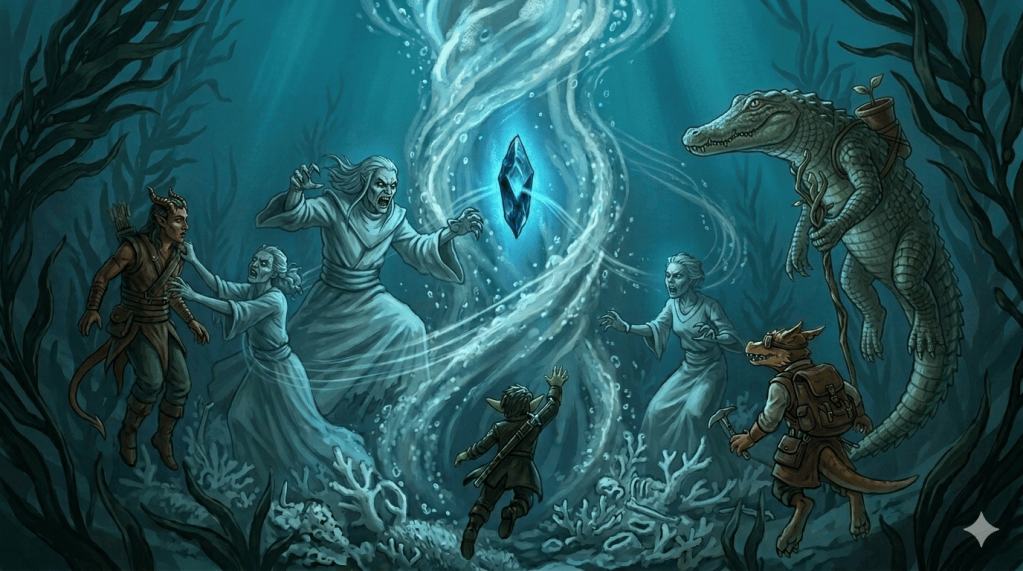
It was not loud. It was not angry. It did not, ever, ask anyone to fight. It only sang the way down. The Watch understood this without needing to discuss it.
There was no air left to fight with anyway.
Pea looked at the column. Pea looked at the splinter. Pea looked at the choristers, who were not, in any meaningful sense, paying attention. And Pea — small Pea, goblin Pea, Pea who is always the first to move — kicked off the seabed and dived into the churning waves.
The current took him. He passed the splinter on the way past and got a hand on it. The choir master did not stop singing.
He came out of the top of the column with the splinter clutched to his chest.
Last Breath
The other three saw it happen. They watched him hang at the top of the column. They watched him not surface. They watched the last of his breath leave him in one round silver bubble and rise away without him.
They watched his body go limp.
It is the kind of thing you watch a friend do and then have to remember, afterward, that you watched it.
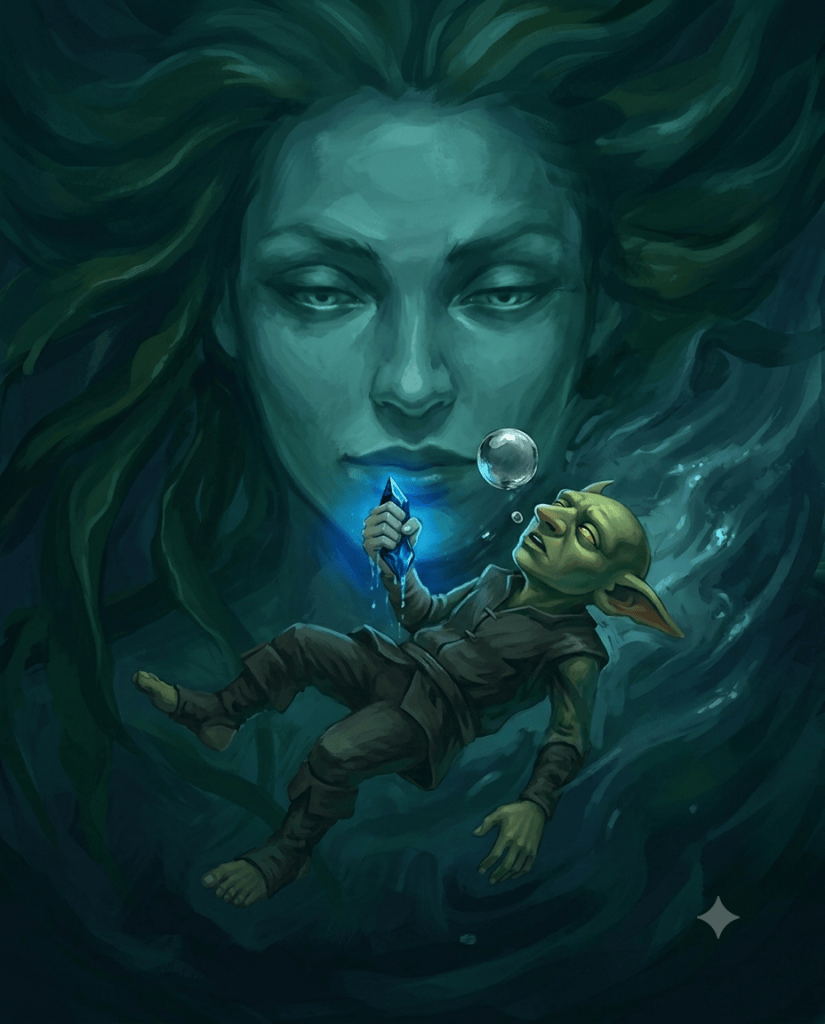
Pea, in the place a goblin goes when he has just given a god the last breath in him, had a conversation. The sea-green woman in the water was patient. She did not require him to know the right names. She asked him only one thing, in a voice he understood the way you understand a tide pulling at your ankles: whether he meant it. The pledge. The devotion. The whole of him, for the whole of her, from this moment to the end.
Pea, who is always the first to move, said yes.
He said it three times, because three is the number that things in deep water ask for.
Breath returned, Pea moved this was his lagoon now and the water obeyed him.
Pea pulled a current — not a slow lift but a strong current, a deliberate hand on the lagoon’s water — and the cold dark depths threw the Watch upward. The water had been given other instructions.
Tink, Pea and Lindon went up together. Kaymos came up last, in the last half-second the splinter could pay for, his lungs already screaming and his eyes seeing white at the edges. Pea decided the order. Kaymos was the one Umberlee’s water grudged the most.
They broke the surface in the order Pea chose.
Escape
They surfaced into a sound they had not heard before — a long, low grinding, coming up through the coral underfoot the way the ringing of a struck bell comes up through a tower.
The lagoon behind them was draining. An inch lower. Another inch. Another.
It came to them as they began to run, the way bad realisations do — not from any one of them but as a single shared oh. The splinter in Pea’s fist had not just been a piece of Umberlee. It had been the thing holding the lagoon in the lagoon, and the reef in the Void. They had pulled out the anchor.
On the southern horizon, the Maw — up to now a background dread — was visibly nearer. The reef was already moving toward it.
The first spire fell.
They ran.
Three hundred yards of brittle petrified coral coming apart in great forking cracks underfoot. Spires toppled. Bridges of coral that had carried them across in the morning sagged and went. A section of the lagoon floor behind them simply fell — dropped out of the world.
Lindon, back in his half-elf shape, set the pace. Tink ran with Embrath at his side. Pea ran clutching the splinter and his eyes a little different than they had been on the way in. Kaymos came last. Kaymos always came last, now. The lagoon had taught him something about that, and the lesson was not yet finished.
The Pale Fang was on the far side of the reef, tilting visibly as the coral that had held her began to slide.
The Pale Fang came off the reef lurching as if even it wanted to flee the storm.
Behind them, the rest of the reef went — in the way a slow ship founders, lighter pieces first, heavier blocks holding another minute and then giving, all of it pouring sideways to be devoured by the storm wall of the Tempest Maw.
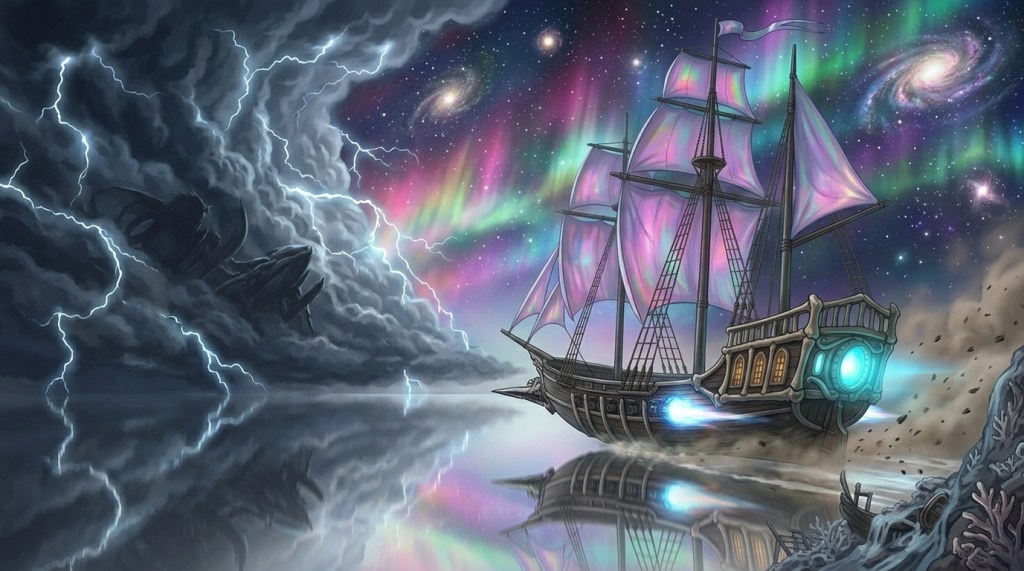
The Pale Fang turned, hard, and ran. Tink pushing the Dwarves out of the way to get to the helm.
The Watch stood on deck and watched.
It was, in some ways, the worst thing the Watch had seen all day. The choir, the splinter, the coin, the wrecks they had nearly drowned in, the hut Tink had swum out of, the kelp Lindon had become a crocodile to get them through — everything — folded into a wall of weather that had not been paying attention. Pea, who had pledged himself to a god a quarter of an hour earlier, looked at it for a long time and did not say anything. None of them did.
The Pale Fang carried them away across the placid surface of the Silver Void. The storm wall of the Tempest Maw at their backs.


Leave a Reply