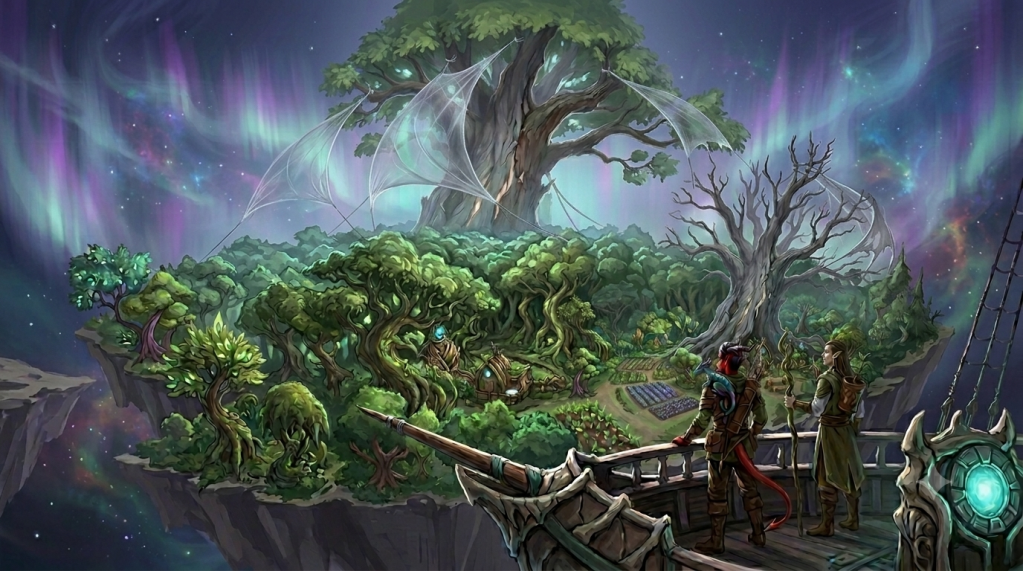
They saw it before they saw the harbour.
The aftmost of Oakhaven’s great oaks stood where it had always stood, and it was wrong. Grey down one flank. Leaves gone thin and pale, like a person being eaten from the inside. The Pale Fang came in across the still silver, and Kaymos and Lindon stood at the rail and watched the sick tree grow larger, and said nothing at all.
The others stayed with the ship: Pea on the deck, the splinter clutched in his clawed hands — a goblin caught between two masters now, the Abyssal demon in the bell at his belt and the drowned goddess in his blood; Veyer keeping a wary eye on a hold full of dwarves; Tink with a hundred things to mend; and Embrath — small, red, and newly a self-appointed commodore — fretting over a newly formed crew. So it was the two of them who went ashore, the tiefling and the druid, into a village that was very glad to see them and a council already at each other’s throats.
The Short Council
The contract was on the table, and the Watch would not sign it.
It did not take long. Lindon read it the way a druid reads a snare. Kaymos just kept finding the places where the trail had been swept too clean. Between them they turned up hole after hole — clauses that gave more than they offered, promises shaped like gifts and weighted like chains. Vaelthris — the Bureau’s devil envoy, installed in the village while the Watch was away — sat through it all with her hands folded and her wings folded, and said nothing she did not have to. She did not push. She did not need to.
Drax wanted it signed regardless. Oakhaven needs walls, he said, and he was not wrong, and that was the trouble with Drax. Valena did not want walls at all. “Walls have never stopped a storm,” she said — to a question that had not been about walls — “only beauty can.” She wanted her ritual, the Summer’s Crown, and every road the conversation took led her back to it.
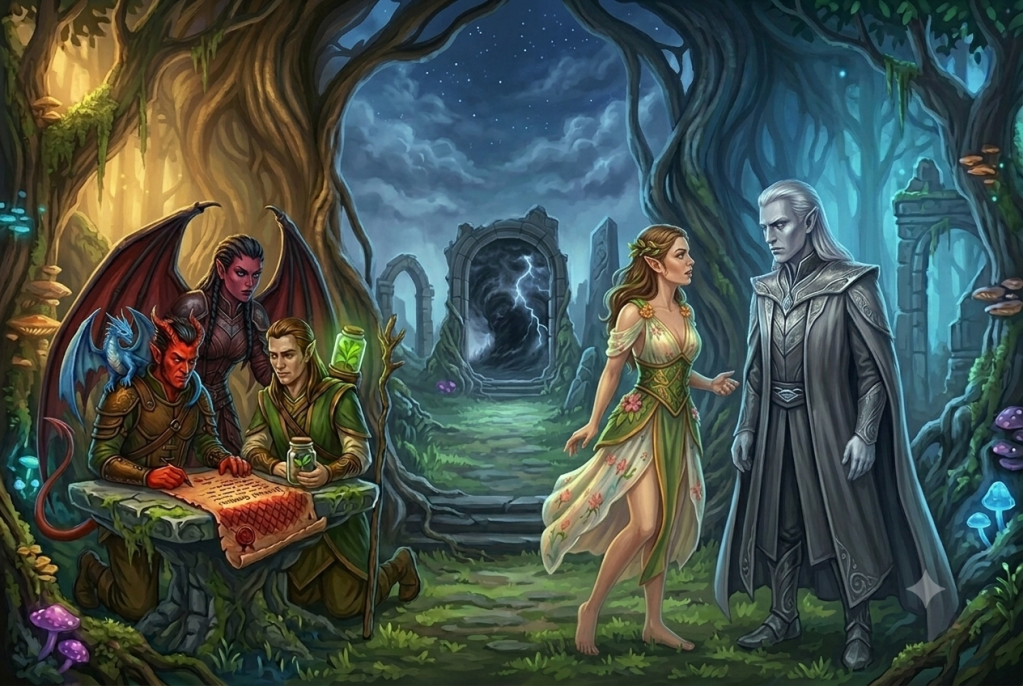
The Watch told the council the thing the council least wanted to hear, the thing they had carried home from a dead commodore’s cabin: the Gith are coming. Maybe in months. Maybe in weeks. The room went quiet around that. Then it went back to arguing.
The Sister
They went to find the dryad of the forward oak, because the dryad of the aftmost oak — the sick one — was not there to ask.
Her name was Yalana, and Yalana was gone: carried off by the Iron Forge dwarves, held somewhere they could not yet reach, and her tree was dying for the want of her. The dryad they could find was her sister, and she was frightened — she could feel her sister dying at the other end of a root they shared.
Lindon asked her the gentle questions first — how long, how bad, what can be done — and then he asked her the one that had been turning over in him since the grove fell quiet around the central oak.
Why does the great central oak have no dryad at all?
She did not know. Or she knew the shape of not-knowing — that there had never been one, that there had never needed to be one, that the Main had always been the strongest of the three and no one had ever asked why. That was worse than no answer. Three great oaks — Fore, Main, and Aft. One dryad left between them, frightened in front of him; one carried off, her tree dying for the want of her; and the Main, the greatest of the three, that had never had a dryad at all — and was the healthiest of them by far.
Lindon’s seedling, on his back, had been pulling all the while. Not toward the sick aftmost oak. Toward the centre. Down.
He looked at it for a long moment, and a great many small things he had not let himself notice lined up at once, and he understood that they were going to have to go under the tree.
The Keeper of the Roots
You do not go under one of the great oaks without asking the right person, and the right person was dead.
They went to Nana Fogbreath first, on her rock, and Nana — who knows a great many things she should not — did not know this one. That was Bram’s, she said. Keeper of the roots. He’d have walked you down by the hand. But Bram was murdered a span ago by Kezreth’s lantern demons and buried in the village ground, and his knowledge had gone with him.
Most of it, anyway. He took the girl down once or twice, Nana said at last, parting with it like a coin she would rather have kept. Marna’s Cloe. She has a knack for getting herself taken places.
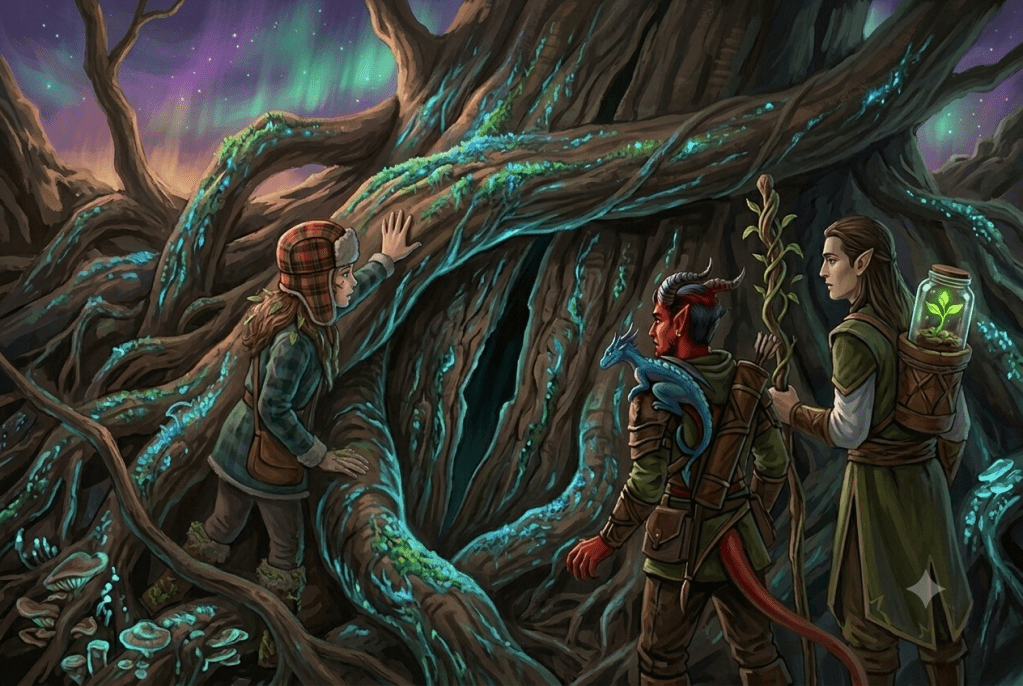
Cloe had charmed her way down at Bram’s side — as she charms her way into most places she is not meant to be — and she had watched what he did at the root, and remembered every step. She knew the way.
She very nearly gave it to them for free. She had her mouth open to do exactly that when Nana cleared her throat. And what, the old hag asked, mild as milk, have we been learning about the worth of a secret, once you’ve gone and told it? Cloe shut her mouth. She thought about it. Then she folded her arms and decided the way down had a price after all.
It was Kaymos who tipped the scales. While she was still deciding, he drew out the hat from the reef — the magic hat that is forever just out of fashion, that none of the Watch could wear without looking faintly, indefinably ridiculous — and made a small, ridiculous show of how fine it was, turning it in the light, settling it on his own head at an angle, until the want of it landed in Cloe’s eyes exactly as he had meant it to.
She wanted the hat.
She got it — and on her, the moment she took it, it settled into a lumberjack’s cap. Nana watched the whole bargain with the slightly proud look of a teacher whose pupil is coming along very nicely indeed.
Then Cloe led them away from the village. The great oak’s roots run further than anyone troubles to think about — out under the hamlets, out past the last houses — and she took them down a tangle of small twisting paths, following the grey wood where it surfaced and dove again, until they came to a place far round the back of the tree, where two enormous roots coiled over and under each other. There she laid her small hand flat against the upper one, and it moved — slid aside like a sleeping animal shifting its leg — and underneath was a slit in the bark just wide enough for one person at a time.
Before they went, two more weights were laid on them. The first was the ritual. It was not one working but a balance of two — the Summer’s Crown and the Winter’s Mask — Valena to raise the Crown, Drax to set the Mask against it and hold the two in balance. Valena’s half was ready: the Crown wanted true love, and she had it — a locket a mortal suitor had pressed on her years ago, back when he was still alive to press it. Drax’s half was the trouble. The Mask wanted an essence of betrayal, and Valena had felt one — a while back, being dragged past Oakhaven and out toward the storm. Could the Watch run it down and bring it back to Drax?
The second weight was quieter. Nana caught them alone, away from the council, and told them there was a third part to the balance — her part — neither Crown nor Mask, that the elders did not know about and could not perform. Summer and Winter would tear at each other, she said; the working needed a still point held between them, and that still point was a mortal soul, freely given — given, not taken. Bring her one, and she would set it at the heart of the ritual and hold the whole thing true. If Oakhaven was to be saved rather than simply won, the Watch would have to be the ones to find it.
They filed all of that away for later. The slit in the bark was waiting.
The Stair
The way down was not dug. It was grown — a spiral stair of living wood, pale and fibrous and faintly breathing, foxfire glowing blue on every third step. Behind them the bark closed without a sound, and the noise of Oakhaven faded to a far-off heartbeat.
The wood spoke as they walked. A voice from everywhere at once, gentle as bark is gentle:
> Speak only truth. Take nothing without leaving its equal. Harm nothing living.
It meant it. This was not a dungeon with rules; it was a law with a stair in it.
And the stair took its toll. Somewhere on the long turning down, each of them lost a small thing — a memory, plucked out so gently they only noticed the hole where it had been. Nothing that mattered. The colour of a thing. A morning from a long time ago. The oak, collecting its fee before it let them deeper.
The Mirror Pool
At the bottom was a pool the colour of old sap, and it did not reflect the room. It reflected somewhere else.
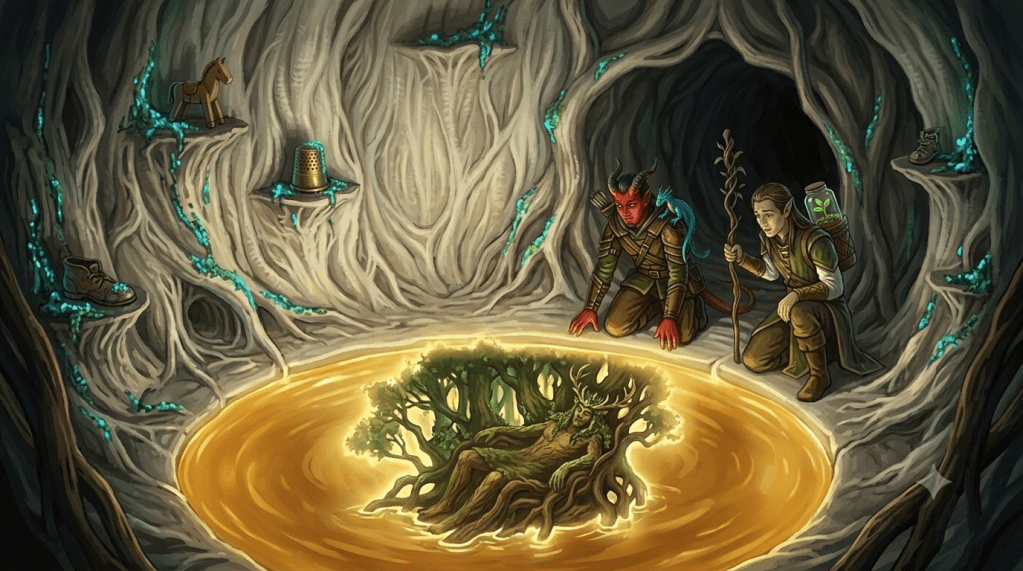
They both looked, and then Lindon drank and Kaymos plunged his head into the cool waters, because this place trades in knowing and knowing has a price, and they had already decided they would pay it.
The pool took a true thing from each of them. From Kaymos it took the memory of the day he found Fizz — so that the little drake still rode his shoulder, warm and real and entirely his, and Kaymos could no longer remember a single moment of how that had come to be. He has the friend and not the meeting. He will feel the shape of that hole for a long time. From Lindon it took something he has not been able to name since — gone smooth, present only as the certainty that it used to be there.
What the pool gave back was the truth they had come for. In the gold water, a figure slept on a throne of living oak roots, crowned in antler and oak-leaf, his skin the colour of bark and his hair moss and ivy, breathing slow and deep while a whole forest grew and unbreathed in time with him. Lindon knew him at once. Every druid would.
Oberon. The Green Lord. Archfey of the Summer Court.
And Lindon, drinking, saw further still: a hand he could not name, ages ago, setting a splinter of the Green Lord into raw soil, and an oak growing up around it to keep it. That was why the central oak needed no dryad. The sleeper was the bond. The oak did not guard the fragment. The oak was the fragment’s dreaming, made into a tree.
The Court, and the Stag
Deeper down, shadows sat on thrones in a half-circle around a thirteenth that was empty, and they wanted to know why the Watch had come.
Kaymos took the empty seat and gave them his answer, and it was not the one they wanted to hear. The chamber did not open. It was Lindon who found the truer words — whatever they were, they were enough — and the shadows inclined their heads and let the two of them pass. Lindon, who had found the words, they marked, as that court marks those it decides to allow.
Past the shadows stood the last thing in that place still awake: a stag, silver-white and horse-tall, antlers spread wide as a man’s reach, amber eyes old and clever. It asked them why they had come — though what it wanted to know, they understood too late, was not what they needed but what they meant to do to the one who slept. They answered the only way the wood permitted, truthfully: they had come seeking aid. Help for a sick oak, a sinking village, a storm on the horizon.
It was the truth. It was also not a no. The stag charged.
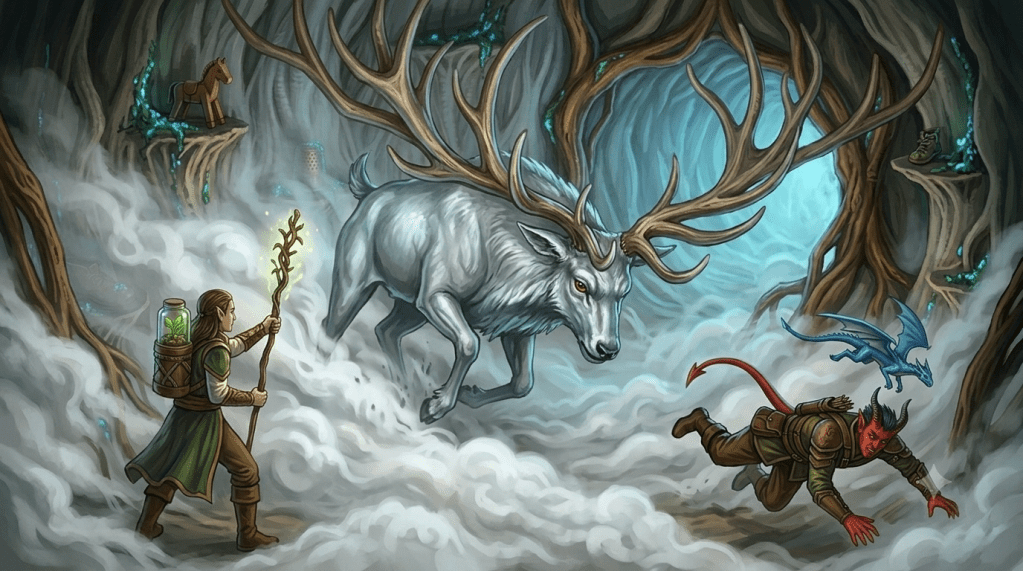
Lindon threw down a Fog Cloud and the chamber went white. Kaymos kept low and kept clear, and between the fog and a great deal of fast, careful talking, they did the thing the stag had not expected anyone seeking aid to do: they convinced it. Not beat it. Convinced it. It stilled, and stepped aside, and let them through to the last room, and there was something almost like relief in it.
The Heart
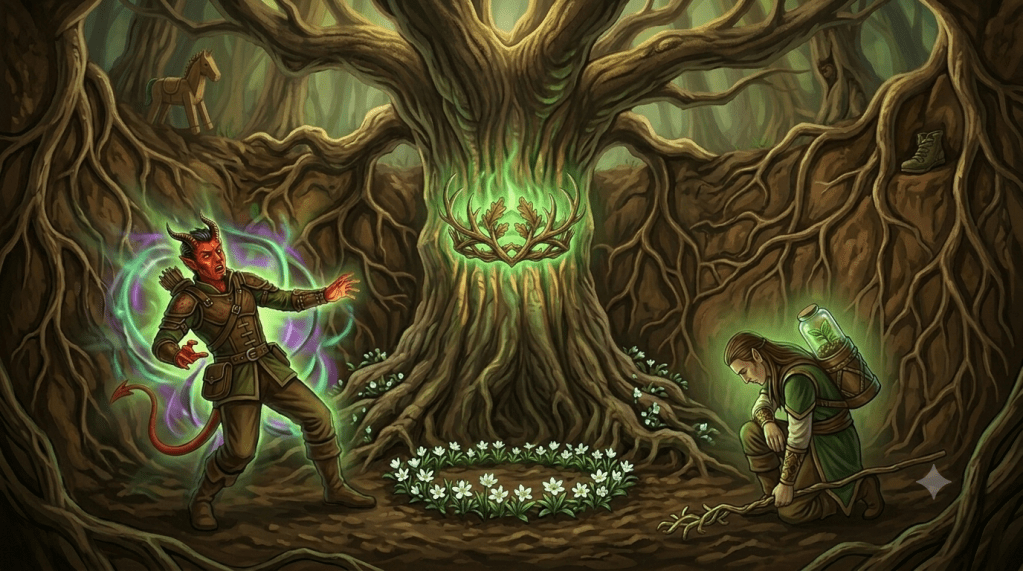
The taproot came down into a small earthen chamber like the inside of a chapel, and at its base, an inch above the dark soil, a crown of gold-and-bark hung in the air and breathed. Antler and oak-leaf, glowing with a slow green light that rose and fell. The sleeper’s breath, made into a thing you could see.
The crown was the fragment. The whole long descent had been a funnel down to this one quiet room.
Kaymos reached out and touched it.
He should not have. The crown is not for the hands of the living, and it told him so the only way it could — a flood of green radiance that went through him like a struck bell and threw him back, scorched and gasping. But something came with the pain. When he got his breath back he found he understood things he had not understood before — the grammar of growing things, the language under the language of the wild. The Green Lord had hurt him and, in the same motion, taught him.
Lindon knelt and spoke.
You may ask the sleeping crown a question, and it will answer, slowly, in your own mind. Lindon asked the only thing that mattered with a storm bearing down on everything he had left to lose. He asked the Green Lord to help them escape it.
The answer came up from below, all at once, with the cold pull of deep water.
> I already am.
That was the whole of it, and it was enormous. The float of the shard, the out-of-season blooms, the unnatural rains, the reason Oakhaven existed at all — every wonder of the place was one sleeping god’s good dream, and the dream could not be woken without being lost.
Lindon rose from that knowing changed. The Summer Court had marked him at the throne; now the Green Lord himself knew his name. Wherever Lindon goes in the Void from this day, the fey of the endless summer will know him for a guest of the one who sleeps under the oak.
They left the crown where it hung. There was never really another choice — not one they could live with. They climbed the long stair back toward the light, and the trivial memories the stair had borrowed came quietly back to them on the way up.
The real ones did not.
What They Carried Up
No one saw them come out. The grove was empty, the bark sealed itself behind them as if it had never opened, and the only soul in Oakhaven who knows they went down at all is a too-charming girl in a lumberjack’s hat, keeping the secret she sold them the way into.
They came up knowing what their village is.
It is not a lucky shard. It is not a stubborn one. It is a sleeping god’s good dream, and the dream has a clock on it, and the storm to the south is patient, and a dead commodore’s message may already be on its way to a queen who eats things exactly like the thing under their oak.
And they came up with errands, as people always do — an essence of betrayal to fetch, a soul freely given to find for Nana, a sister to bring home to a dying tree. And one thing no errand would ever mend: a friend whose first day Kaymos can no longer remember.
Below, deep in the roots, the Green Lord dreamed on — and his dreaming held the village against the merciless pull of the Tempest Maw.


Leave a Reply