Somewhere out in the dark, a shard of the Shadowfell went into the Maw.
Nobody could say quite when — time runs strange near the rift — only that it was seen: a jagged grey rock of a place, all gloom and hard stone, never much light in it to lose. It leaned, and slid, and the storm folded it in. One more small world gone. And the storm was not waiting for the next one to drift within reach. The Maw was growing — swelling outward across the sector, and Oakhaven lay in its path. Four months, perhaps six, before the storm-wall arrived. If it didn’t quicken.
So when Elizar named the Watch’s next destination, he named it by feel, because feel was all he had. Somewhere out there, on a shard the Maw would swallow long before Oakhaven, sat a thing that reeked of old betrayal — cold despair pressed into stone until the stone had learned to keep it. Exactly what Drax needed for the Winter’s Mask: the dark counterweight to Valena’s love, the second half of the working that might wake Oakhaven into something that could fight. “It will be gone long before we are,” Elizar said, “and sooner every day you wait.”
He did not know it was a palace. None of them did. Only that it was falling, and that it hurt to be near.
Three of the Watch went: Kaymos and his drake, Veyer, and Lindon. The rest held the Pale Fang.
What Nana Said
Before they sailed, Veyer went to Hushing Rock. In an earlier lesson Nana had mentioned, almost in passing, that the elders’ working would want a third weight to hold it true — a soul, freely given — and the phrase had snagged in Veyer like a thread on a nail. She came back to pull at it. A soul given by whom? Given how? Freely meaning what, exactly?
Nana reached up — she had to reach, with a Goliath — and rapped her once, smartly, on the brow.
“Pay attention to the words, girl. All of them. People put their whole lie in the small ones.” And she would say no more, and sent Veyer back to her ship with a tincture and a smile that did not quite reach her river-stone eyes.
East, and Quickly
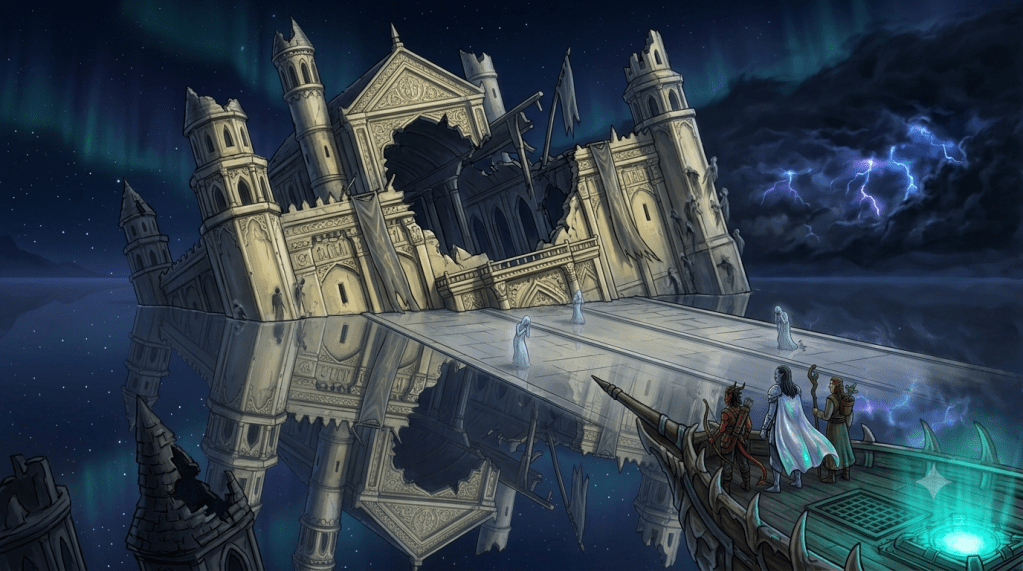
They found the city first — the broken bones of a drowned metropolis, turrets and rooftops and snapped spires jutting out of the void like the masts of a hundred foundered ships. Somewhere in the heart of the wreckage, larger than all of it, the shard they had come for.
Getting through was slow, careful work: drifting slabs, dark rents in the void, a broken tower turning end over end across their line. The three at the rail called the hazards as they came while Tink eased the Pale Fang through gaps that kept not quite being wide enough. And the nearer they drew, the stranger it grew — the colour bled out of everything. Grey stone greyed further; even the psi-core’s teal seemed to dim. By the end they were creeping through a world with the hue drained from it, toward the palace that was doing the draining.
Tink brought them in as close as he dared and not one length closer — the Maw’s storm front stood close behind the palace, filling far too much of the sky. He held the ship off a broad flight of steps below a tilting plaza of pale yellow stone, and the three went the rest of the way on foot.
The Plaza
The plaza was full of the ghosts of the dead, and none of them were dangerous unless you touched them.
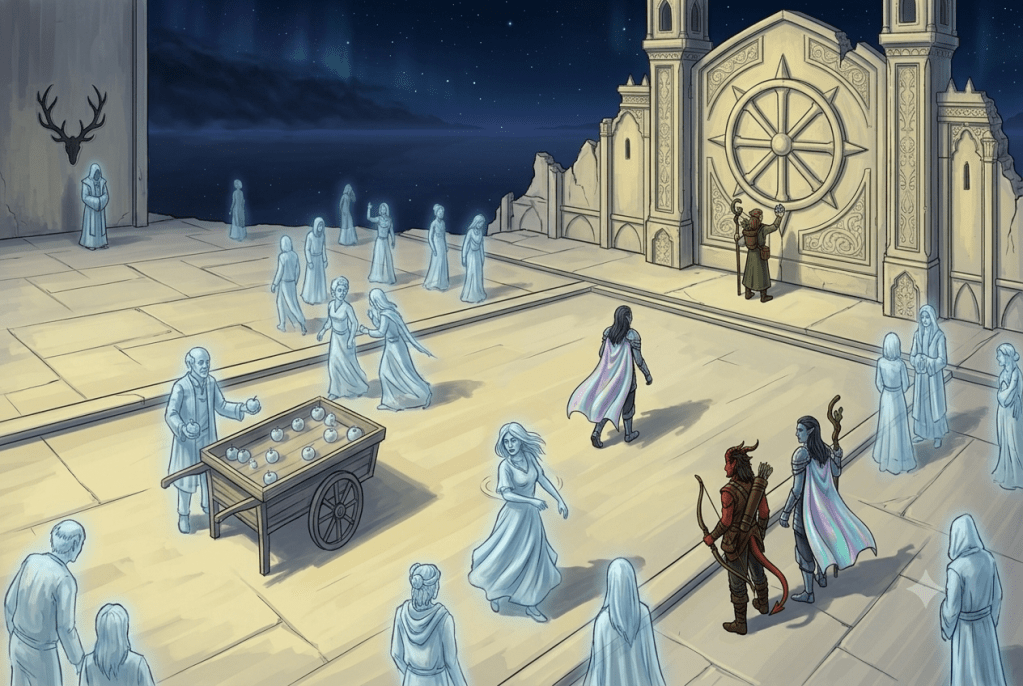
They moved in loops. A merchant stood over an almost-empty apple cart, offering the same three apples to a crowd that had stopped coming a hundred years ago. A woman turned on the spot and turned again, searching the empty plaza for a face, calling a name the void had long since swallowed. Whatever each had been doing the instant the world broke, they were doing still. None of them noticed the Watch pass.
At the broken palace gates, Lindon stopped. Carved into the stone was a wheel — eight spokes — and it was the same wheel as the pendant he’d been carrying since the reef. Not a pretty mystery any more. It belonged here. It belonged to this dead house, and it had been sitting in his pocket for a span or two — who counts time in the void anyway? — while he had no idea whose it had been before him.
He did not say much. There was not much to say that wasn’t a question he couldn’t answer yet.
Kaymos found the priest: the one shade not looping, a robed figure standing utterly still before a carved sign of black antlers, an amulet of the same shape pulsing slow and cold at his neck. Kaymos tried talking to him. It got him nothing and cost him plenty — the priest’s ill luck rolled off him onto whoever stood nearest, and Kaymos was nearest. Dust found his eyes out of still air. His foot found a column. A grind of stone overhead sent him diving full-length across the flagstones to clear the falling masonry — which arrived, when it arrived, as a thin patter of pebbles. He came up filthy, furious and mostly unhurt, which was somehow the most insulting part.
Lindon ended it. Cold moonlight fell on the still priest, and the last of him came apart in the light and did not reform. The black-antlered amulet dropped ringing to the flagstones, still pulsing. Lindon hooked it up on the end of his staff, held it well away from himself, and it went — wrapped twice in oilcloth — to the very bottom of a bag of holding. A live coal in a sealed tin.
The Herald
Through the gates was a vaulted antechamber, its ceiling painted with the dead house’s glories — and every royal face in all of it scratched hollow. In the corner, at a writing desk, a ghost in a herald’s tabard had been waiting a hundred years for somebody to come, and was almost too tired to be glad they had.
He gave his name as Aldric, asked for theirs, and used them. He did not pour it out unprompted; it was Veyer who drew the story from him, question by question.
There had been a king — Edran Voss — and the king had betrayed his people. Sold them off: a tithe here, a plague-route there, a whole village at a time. The walls would not let the Watch doubt it — even with every royal face chiselled away, the carvings still told on him, up on his balcony, posture unmistakably delighted, while lines of his people were led off below in chains. He had watched, and he had enjoyed the watching.
But the king, Aldric said, was the puppet, never the hand. The hand was the priest from the plaza — Brother Cadmus, the snake behind the throne, servant of a goddess of ill luck, who had chosen Voss precisely because a vain, greedy king would sign anything set before him. For thirty years Cadmus fed the court’s engineered misery to his goddess and called it governance. The king took the pleasure. The priest took the souls.
When Veyer told him the priest was already gone — unmade in a column of cold light not an hour past — the old herald shut his eyes, and did not open them until he was sure of his voice.
He had found the honest ledger himself, he said, and made his one great error: he went to the king first. It bought Cadmus time to prepare. By the day Aldric laid the books before the full court, the priest was ready to hang it all on the puppet — and then the world shattered, mid-sentence, and the truth never finished arriving. A torn, scorched scrap of that ledger still lay by his desk. The Watch took it, spoke their thanks, and moved on. There was nothing else the herald had left to give.
The Gallery
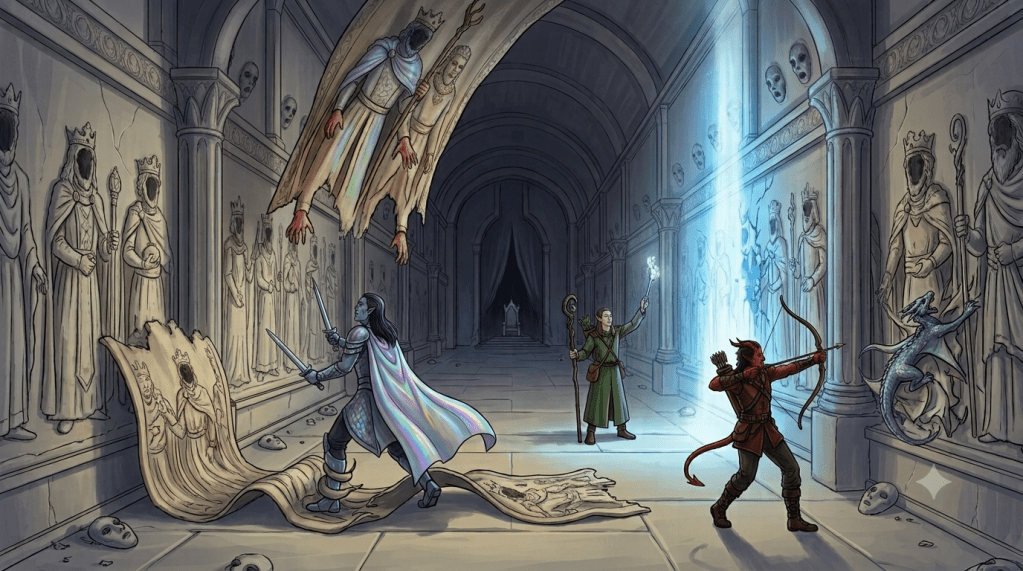
Aldric’s doors opened onto a long gallery built to make a person feel small: the ceiling too far up, the throne visible at the distant end and made to loom, the walls carved and hung their whole length with the king’s processions, so that a supplicant arrived at the dais already reminded of exactly how little he was. Architecture as a boot on the neck. It had outlived the man who set it there.
The gallery let them get halfway down before it moved. Then the paintings peeled off the walls — sliding across stone and floor like oil finding a drain, the grievance in them come loose at last. Lindon dropped cold moonlight into the middle of them and the nearest frayed at its edges. Kaymos called the wind into his feet, crossed half the gallery in a step, and put an arrow through a thing from the side it wasn’t watching. Fizz shredded a canvas to flapping ribbons, thoroughly pleased with himself.
Veyer got the worst of it. One came at her low, slithering across the stone and winding up her legs tight as a net; while it had her pinned, a second dropped from high on the wall, meaning to fold her up between them. She cut herself free — she is not a person who stays caught for long — but the place had picked her on purpose.
And the faces drank. The gouged-out kings, holes where their faces should have been, fixed on Lindon and pulled — and what they took did not come back when the fight ended. Healing slid off it. It sat on him like a curse: a measure of his own life simply gone, until Oakhaven, and Helios, and a remove curse — if they got him home. He kept walking anyway.
The Throne
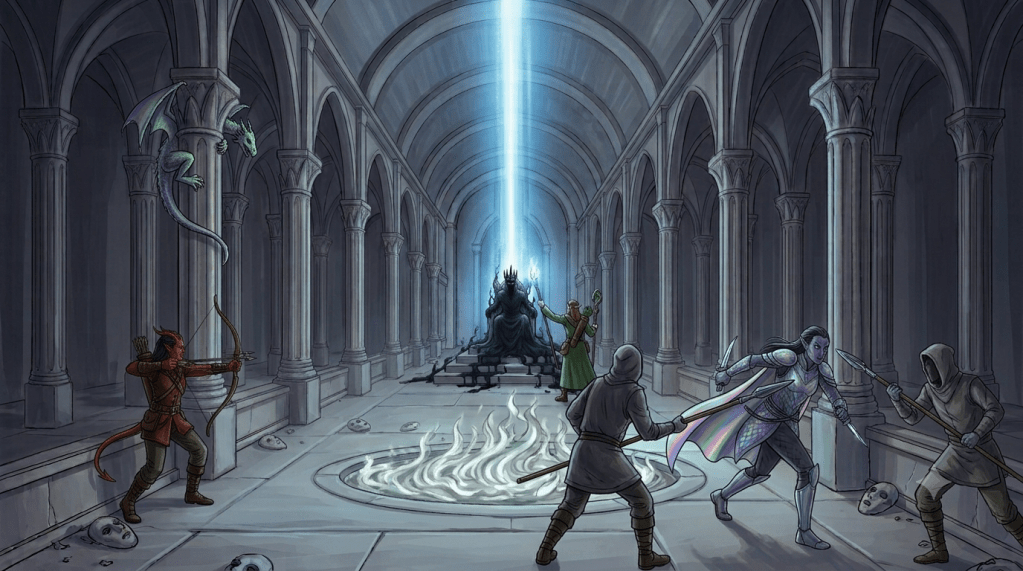
The throne room was the only whole room in the palace, and the thing on the throne had kept it that way. The same cruel arithmetic as the gallery: a vast cold floor, a high dark ceiling, a dais that forced you to look up. The Court had been shaped to make supplicants feel small. It was still trying.
The thing sat hunched and faceless, a man-shaped pour of cold dark that beaded and rolled and never held still, its hands wringing and wringing at a stain that was not on them. And it whispered — to each of them alone, pressing a thumb into the softest doubt it could find. It whispered to Veyer about taking what is not given. It prodded Kaymos about the lost memory of the day he found Fizz — the day the pool took, the day he cannot reach. It whispered to Lindon about whose pendant that really was.
Each of them stood a moment with a voice in their skull, and put it down, and got on with it. The Shadow was good at finding doubts. It was less good with people who had already had the argument with themselves and lost interest in having it again.
But it would not give up its lie for a flat refusal, and when the Watch pressed in, the king fought. Every wound the dark took, he lifted a wringing hand and a guard peeled out of the gloom — faceless, gouged smooth, carrying a man-catcher: a long pole ending in an iron half-ring, forged not to kill but to take people away. There were cells behind the throne for exactly that. Five guards came, one after another, as fast as the Watch could put the king’s dark down.
Kaymos took the first before it reached him — he had seeded the floor with arrows, a cordon set to wake when anything crossed it, and the guard glided straight into them and came apart in the air. The next caught Veyer: a half-ring closed on her and hauled her toward the cell-arch. She did not wait to be freed. She filled the air around her attacker with a whirling cloud of daggers, shredded it to cold rag, and stepped out of the wreck already hunting the one after. Lindon kept moonlight burning on the king throughout — cold, patient — so that each new guard came apart faster than the last.
It was Veyer who finished him, with three truths, each landing where the lie could not cover. That he had betrayed his people — a king does not sell the subjects he is sworn to keep. That he had held no right to the throne — no god set him there; the only divine hand in this palace had been Beshaba’s, and she came to feed, not to anoint. And last, with the dark already sagging: he had traded thousands of living souls into misfortune — and for what? A hundred years adrift. A chiselled-out face. A palace sliding into a storm. For nothing. For this.
The Shadow had no answer, because there was none. Pinned in the moonlight, named to its face, it stopped pretending it had not been seen — and it gave up the throne. It retreated, shrinking in on itself, condensing down and down into a roiling, oily mass of dark that still, faintly, wrung at itself: the essence of the betrayal of an entire kingdom, distilled.
And it was Lindon, in the last heartbeat, who saw what his own light was doing — the condensed thing burning away in the beam, the prize they had crossed the dying dark to fetch boiling off in cold moonlight. He killed the spell. Kaymos was already there with a waterskin unstoppered, and scooped the king’s lie inside, and clamped the stopper home with the thing still whispering.
They had it. They had very nearly destroyed it. They decided not to dwell on the second part.
The Palace Falls
Pulling the Shadow loose did to the Court what pulling the splinter had done to the reef. The floor leaned. Marble cracked in long forking lines, columns sagged, and the whole long grief of the place began to slide toward the storm that had been reaching for it all along.
Kaymos stopped to dig the diamonds out of the throne’s settings.
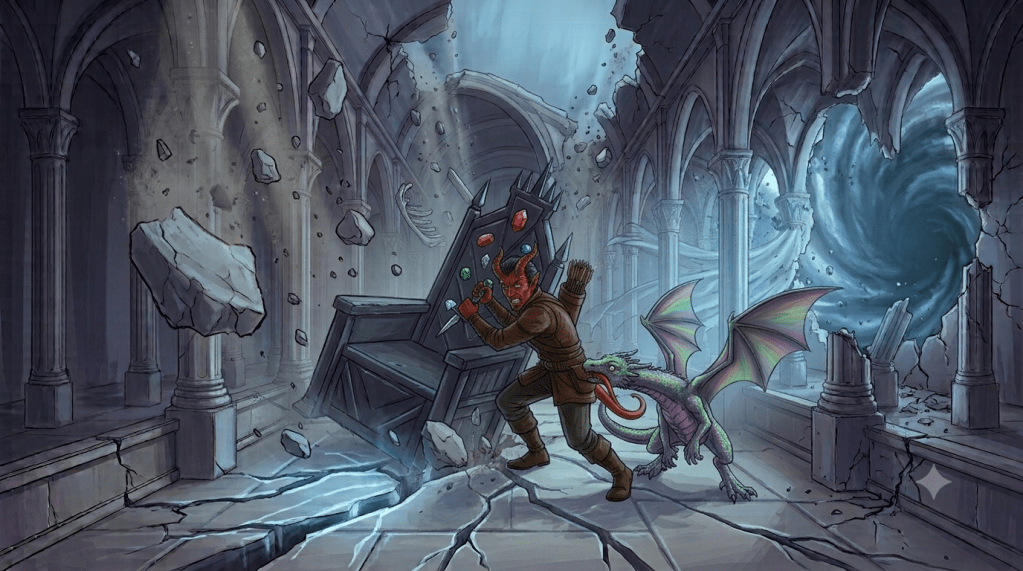
No sensible reason for it; every Kaymos reason for it. The Court was tipping its centuries into the rift and he was crouched at the dais with a knife — hunting diamonds specifically, ignoring everything that merely sparkled — while Fizz hauled at his sleeve with both foreclaws and every alarmed instinct a drake possesses. He came away with a fistful before the drake bodily dragged him toward the breach where the others were shouting his name. Back aboard, he pressed the diamonds on Lindon without ceremony. Spell components. No further comment offered.
They made the rail of the Pale Fang as the last hall folded inward. Behind them the Drifting Court tipped the whole of itself into the Maw at once — towers, banners, the looping dead, the gouged kings, Aldric at his desk — and the storm took it the way it takes everything, without hurry and without noticing. Where a palace had drifted, there was nothing at all.
The pendant in Lindon’s pocket went cold and quiet, like a thing whose home had just stopped existing. In the waterskin at Veyer’s belt, very softly, something went on wringing its hands.
Elsewhere, in the Dark
Somewhere the silver turned to oil, and a black hull rode the dark.
On its deck a thing that was mostly shadow — the dybbuk Silas Kross, who had worn other men before this one — knelt inside a stolen body it had not finished settling into: a dead sailor’s face, worn slightly wrong, as if put on back to front. Above it loomed something you did not so much see as notice by where the starlight refused to go: Thraxxia, Admiral of Shadows.
“You let a goblin keep my bell,” the Admiral said, in a voice past anger. “And the sea has put its mark on him. My property. Smelling of fish.”

The stolen mouth smiled with someone else’s teeth. “They took a splinter from a reef, Admiral. Now they’ve gone chasing a dead king’s lie. Givers, takers, little heroes.” The voice was oily and aggrieved, a man forever owed. “Let me go and be among them. I’m so very good at being among people.”
A long, lightless pause.
“Bring me the bell,” she said. “Bring me the lie. And the goblin, if he still fits in a sack.”
Silas Kross stood, tested the dead man’s knees, and turned his ruined eyes toward the silvery void.


Leave a Reply