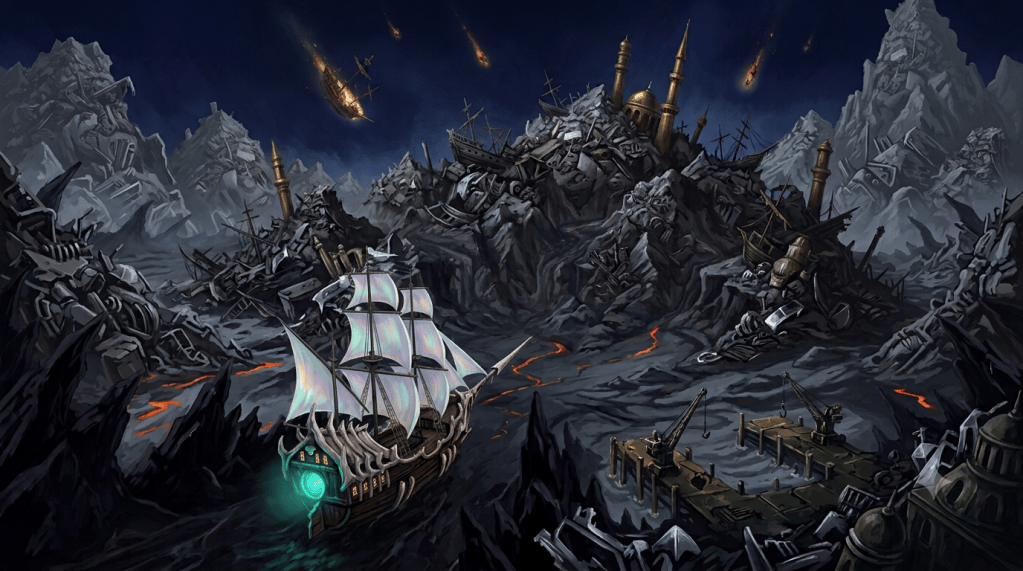
Adrift in the Silver Void there is a fragment of the City of Brass — torn loose when that burning city broke, and carrying its own weather with it: a sea of fire ringed with black obsidian reefs, and at its centre an island made entirely of what the City has lost. Scrap falls out of the sky there — hulls, engines, gates, whole dead ships sliding down out of the dark to crash onto mountains of older wreckage — and the mountains grow, and the lava carves canyons through them, and everything ticks, day and night, with the sound of hot metal slowly cooling.
The salvagers who live there call it the Heap. They will also tell you, if you keep your voice down, that the deep parts of it have stopped ticking.
The Watch came to the Heap for a dead man’s face.
Bell on the Docks
The warning bell started before the Pale Fang had even cleared the reef-lane.
From the water, the Heap’s dock is a crumbling brass lip under a wall of scrap-mountains, and by the time the ship’s lines were in sight the whole of it was moving — cranes swinging round like turning heads, harpoon-throwers cranking taut, soot-streaked figures scrambling to stations. Because the silhouette coming in off the fire-sea was bone-plated Githyanki iron, all cruel angles, and the Heap has met that silhouette before.
On the dock, a young salvager lay bleeding out around a sliver of steel the length of a forearm, driven clean through his shoulder. The medic kneeling over him — a broad, patient soul the crews called Solder — did not look up at the bell. He finished the work first: drew the metal, pressed a holy symbol to the wound, and held it there while the symbol glowed stove-hot and seared the flesh closed. Then he stood, wiped his hands, and ran for the harpoons like everyone else.
At the pier’s end, a barrel-chested man with grey stubble and a brass boarding-hook where his left hand should have been bellowed across the water: “Far enough! One more length and we put a harpoon through your keel!”
What saved the day was Veyer.
She came up onto the bow with her cloak streaming, arms spread wide, every inch of her seven feet arranged for an audience, and pitched her voice to carry over the alarm the way only a performer can. “We’re here for trade — and happened to have borrowed this ship from the Gith!” And whether it was the words, or the delivery, or simply the sight of a goliath bard, a goblin, and a druid where a raiding party ought to be, the harpoons came down. Slowly. One at a time.
The man with the hook — Foreman Sarn — looked the ship over for a long moment, and something behind his eyes changed from threat to opportunity.
“You’ll want the Madame,” he said. “Everyone does, eventually. This way.”
The Hot Way
Behind the dock walls, the Heap opens up — and it is not a junkyard. It is a country. Mountains of compacted wreckage rising range behind range, canyons between them where lava has cut the scrap like a river cuts stone, and below the docks, filling the bay, an ocean of fire — with rivers and streams of magma oozing down out of the interior to meet it, glowing seams stitched across a black shore.
Sarn’s crews led them in. Slox — an azer forge-hand, living bronze with a beard of flame — set off the short way, straight past the working forges, through air that shimmered like water. It was Solder who took one look at the party, weighed what that heat would do to flesh that wasn’t bronze, and quietly turned everyone onto the longer, cooler road instead — no fuss, no debate, just done. It was the kind of small competence that tells you a great deal about a person.
The long way earned them the full tour: smith-gangs stripping hulls, ash-sifters combing warm cinders with scarred fingertips, and — everywhere, always — the tick-tick-tick of the cooling metal, like walking through the workings of an enormous clock.
The Chateau of Madame Vespa
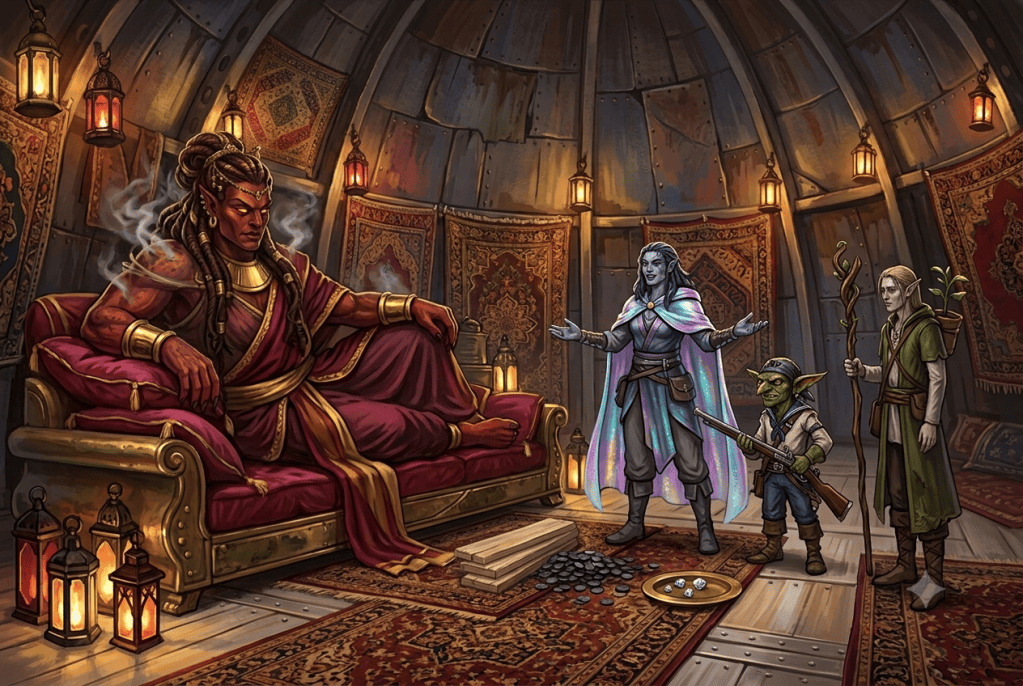
Madame Vespa rules the Heap from a palace built of salvage — a dome of mismatched hull-plates hung inside with Moroccan tapestries, ship’s lanterns burning in ordered rows, carpets laid over polished deck-plate. It should look like a scrap-heap playing dress-up. It doesn’t. It looks like wealth that has stopped needing to prove anything.
She is an efreeti: twelve feet of banked-coal elegance, skin the deep red of cooling iron, gold at her wrists and throat and nowhere warm in her smile.
The trading came first, because with Vespa the trading always comes first. Wayfarer wood and demon-stamped coins crossed her table; diamonds came back the other way — Lindon had his own quiet reasons for wanting diamonds, and nobody pressed him on it.
Then the Watch told her what they had actually come for.
Deep in the maze, somewhere in her Heap, lies a funeral barge aground — the tomb of Pasha Sohrab, a City of Brass noble betrayed and murdered by his own vizier an age ago, launched down the lava rivers in the custom of his people and washed up, in the fullness of time, here. On his bier lies a death-mask of mirror-bright platinum, cast from his dead face, which still wears the exact shape of the moment he understood what had been done to him.
The Watch needed that mask. It is the metal the Winter’s Mask must be forged from — a face that died betrayed, for a working built on an essence of betrayal.
It was the Watch’s negotiation from start to finish — they set the table, made the offers, drove the trade. And Vespa let them. She heard them out with the stillness of a merchant who has just been handed something better than money, and when the shape of what they wanted was fully on the table, she simply steered the deal the one place she needed it to go. The Heap is hers; nothing is salvaged from it without her word. They could have their access — and the mask with it — for one small errand folded into the bargain: “Zere is a brass seal-ring on ze bier. Bring it to me, oui? A trifle. Sentiment.” She said it lightly. She said it a little too lightly.
Her crews would guide them as far as the frontier, she said. Past that, her crews do not go. She has sent two salvage parties toward that barge in the last month.
Neither came back.
Into the Maze
They went in six: Veyer, Pea, and Lindon of the Watch, with Cinder, Solder, and Slox — three of the Heap’s own, who knew its rules and had never once broken the big one: don’t go deep.
Somewhere in the first canyons, Pea decided it was time Veyer knew. He pointed at a pile of rock, said nothing at all, and fire fell on it out of the empty air — white, silent, and gone. Veyer stared. Pea shrugged, in the way of a goblin who has drowned once, made three promises to a sea-goddess, and come back different, and kept walking.
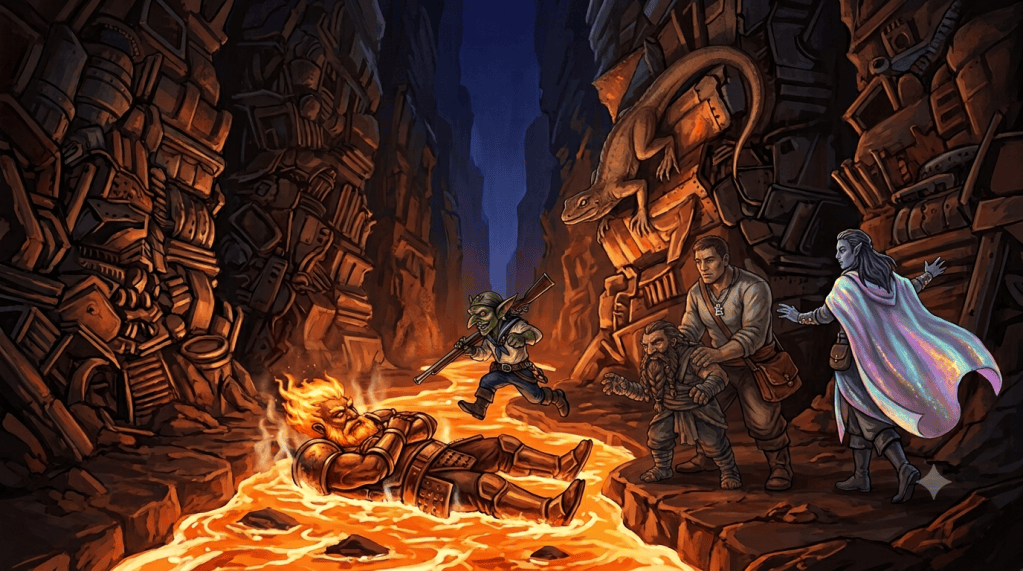
The maze tested them early and often. A nest of magma mephits held a wrecked hull across their path — but the little horrors were busy screaming at each other, and the party ghosted past them in perfect silence and never looked back. Lindon, tired of scrambling, poured himself into the shape of a giant lizard and simply walked up the scrap walls, picking out the safe lines from above. When they needed to stop and think, they went to ground under a fallen portcullis, iron bars overhead, and planned in whispers.
And when a stream of live magma cut the only path, Slox looked at it, looked at them, and lay down in it — arms crossed, perfectly comfortable — so the rest of the party could use him as a stepping stone. He came up steaming and pleased with himself.
But the deep parts of the Heap had their own hazards. Twice the scrap moved on its own — long avalanches somewhere out of sight, the whole landscape groaning as it resettled. Once they watched fresh wreckage fall out of the sky itself, tumbling down through the red glare to crash onto a far ridge. And underneath all of it, stretch by stretch, the ticking was going quiet.
Pea saw it first. Half a mile off, across a canyon: a mound of scrap that unfolded, poured over a ridge on a ripple of countless legs, and was gone into a junk heap. Nobody said anything for a while after that.
Plateau of Claws
They found the open ground near the middle of the maze — a wide plateau of fused slag, and on it, scrape-marks. Then more scrape-marks. Then, as they crossed it, a multitude — claw-gouges by the hundred and long drag-furrows between them, laid over each other, old and new together. Each single gouge was the width of a boot. Whatever had left them, it was big — big enough that the ridge Pea had watched pour itself into a junk heap half a mile back stopped being a curiosity and became a measurement.
Lindon, standing amid the claw-marks and counting everything else back — the avalanches with no cause, the ticking that kept dying just nearby, the glimpse that had melted away the moment it was seen — said aloud what everyone was half-thinking. Those weren’t accidents of a restless landscape. They were the pattern of something keeping pace, staying out of sight, choosing its moment.
They were not walking through a predator’s territory. Something large and cunning was hunting them — and had been, possibly, since the frontier.
The Dead Camp
They found Vespa’s second crew — what was left of them — camped where they had died.
The camp had been picked clean the way no scavenger picks: straps cut, buckles taken, gear sorted from bones. Among the wreckage, a torso. No legs. Nobody said much. Solder knelt, the way he clearly had a hundred times on the docks, and began looking for anything personal — something with a name on it, something to carry home to whoever was waiting.
That was when the wall burst.
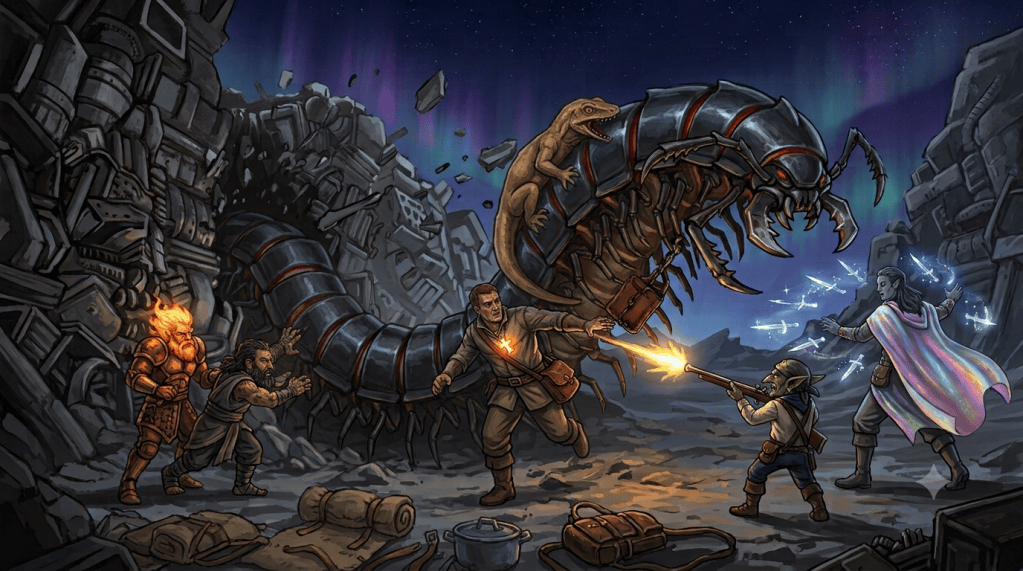
It came out of solid scrap without a sound of warning — a segmented horror of brass-black plates and furnace-glowing seams, longer than the Pale Fang’s launch — and it did not go for a kill. A barbed limb lashed out, hooked Solder’s scroll case off his back, and the whole impossible length of it was already pouring back into the junk.
The party hit it with everything as it went. Cinder got a stunning blow into its back half that made the plates ring. Slox got both bronze hands on a trailing segment and held. Lindon — still a giant lizard — lunged, clamped his jaws on its carapace, and discovered that giant lizards have no teeth to speak of; he gummed the monster with tremendous conviction and total lack of effect. Veyer filled the air around it with a storm of conjured daggers. And Pea put his musket into it at point-blank range —
— and the shot echoed. Off the canyon walls, off the scrap cliffs, rolling out across the deep Heap like a struck bell. And in the distance, in answer, something else moved. Another mound. Another ripple of legs.
There was more than one.
The thing they were fighting thrashed, and it hurt them — claws opening Solder up, and catching Lindon worse. Lindon has not been whole since the Drifting Court took its permanent toll of him, and everyone saw how shaky he was when the blood started. Solder scrambled after his scroll case; it was Veyer, all reach and impossible nimbleness, who plucked it back off the barb in the last instant before the creature vanished into the heap entire.
Then silence. Then, faintly, somewhere below their feet: movement, keeping pace.
From that camp onward, they were never alone again. A glow behind a wall. The ticking, stopping, always just nearby. It was following them — patiently, intelligently — all the way down.
The Barge on the Fire
The last stretch nearly beat them without the monster’s help. There was no road at all — barely a pass — and they had to forge their own way through the junk along the banks of a lava river, shifting wreckage hand over hand with the heat of the current beating up at them. Slox — of all people — took the lead and lost it, the bank crumbling under him, and nearly put the party in the fire; it was Cinder who read the slag right and picked out a line that held.
And then they saw it.
A funeral barge of black iron and gold filigree, jammed clean across the lava canal like a bone in a throat — damming it, the fire piling up and bleeding around its hull — and lit all along its length by the red glow of the flood it was holding back. And amidships, on a raised bier, something small threw the glow back at them: mirror-bright, cold, perfect.
The mask.
They did it carefully, for people being hunted. From the shore, Pea and Veyer read the barge with sorcery before anyone touched it: the mask on the bier; a ring; a scimitar that sang of old power — the Pasha’s own blade — and beneath all of it a deep, patient enchantment in the barge itself, and in the tall still figures ringing the bier. Lindon unpicked the barge’s magic from a distance — and learned, a moment too late, what that magic had been for. The enchantment was the only thing keeping the fire from claiming the hull. Stripped of it, the black iron began, very slowly, to melt: the whole hulk groaned and settled a hand-span deeper into the magma, and the fire crept a little higher against its side. Whatever they were going to do aboard it, they now had a deadline.
So Veyer and Pea went aboard alone, quiet as thieves, while the rest held the shore.
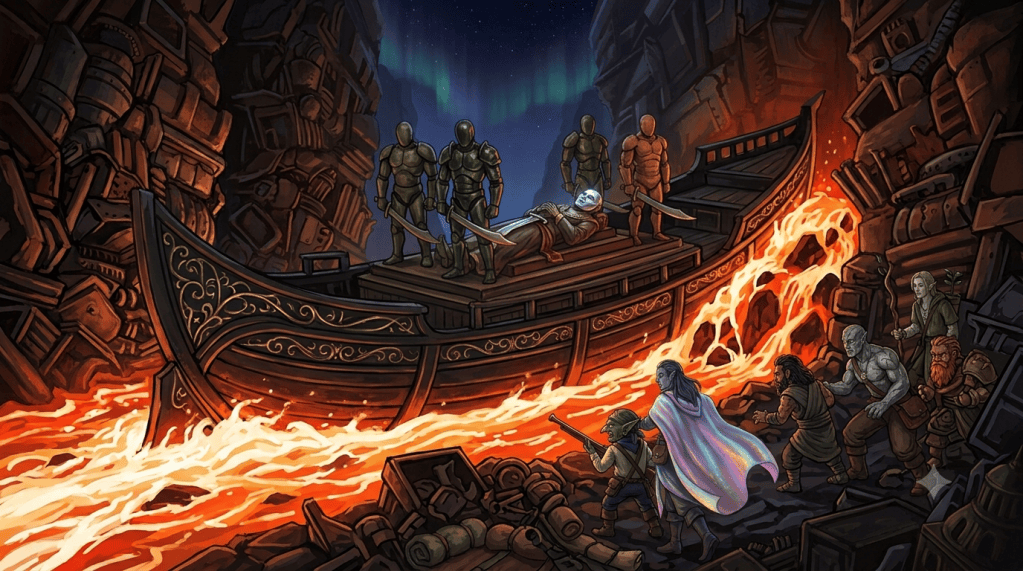
What they found on the bier was the Pasha himself — desiccated, regal, his ruined face turned up under the platinum copy of it. There was no ceremony left in what happened next. Veyer took the mask, found it would not part from the corpse — and snapped the dead man’s neck, taking head and mask together. Pea claimed the scimitar — and the Pasha did not give it up. The dead hands were still clenched tight around the hilt, and when Pea wrenched the blade free they came away with it, ring and all, snapped off at the wrists. He stuffed the lot — blade, hands, ring — into the bag of holding.
Which is when the honour guard woke up.
Everything, All at Once
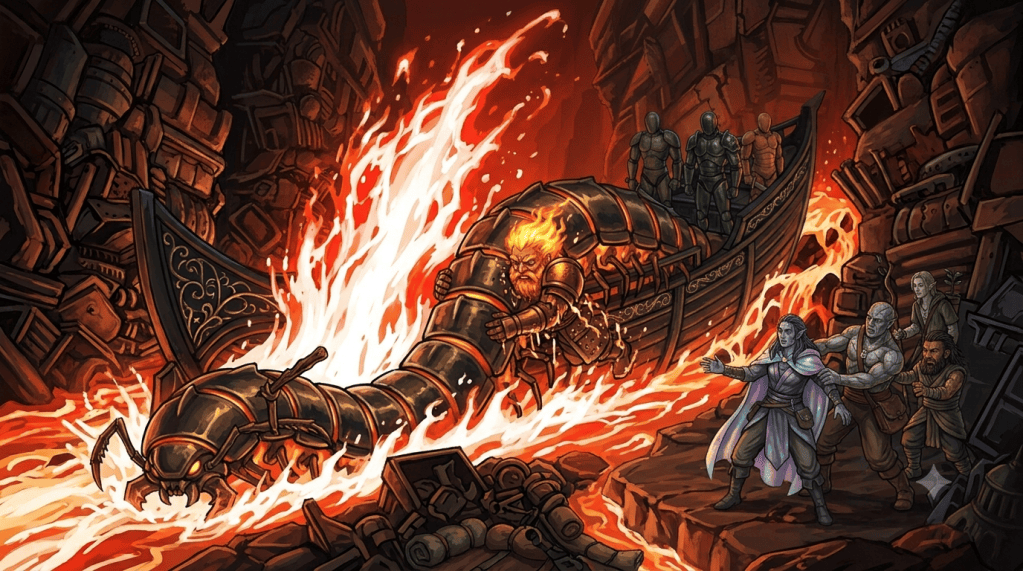
Four golems stepped off their plinths — brass and fired clay, scimitars the size of boat-oars rising, moving with the slow certainty of poured metal. And in the same heartbeat, as if it had been waiting for exactly this noise, the Heap’s hunter came up out of the scrap on the shore.
It went for Solder first — for the scroll case again, of all things, as though it had been thinking about that scroll case for hours — and failed to take it, and opened Cinder up instead. It caught Lindon another cruel blow in passing. Solder’s hands were already glowing; he had healed them both once today, and here it all was again, undone in seconds.
Nobody needed to call the retreat. The party broke and ran — misty steps flashing, boots hammering the slag, six people threading between a monster and four walking tombs — and the creature, true to its nature, did not stand and fight either. It struck once more as they fled.
It took Lindon’s staff. The Hand-Warming Staff, warm as a hearth, snatched clean out of a druid’s grip by a barbed limb — and then the thing dove headlong into the lava river, gone in a sheet of fire that splashed Lindon, Solder, and Cinder as it vanished.
And Slox — bronze, burning, furious Slox, who had held it once already and did not let things go — jumped after it.
He got his grip. The last anyone saw of him, he was locked onto the creature’s plates as it plunged, and the two of them went down together into the fire and were dragged under the barge’s black hull — scraped beneath it by the current, down where nothing that is not made of flame can follow.
Whether he ever let go, no one on that shore could say.
Run Home
The rest is a blur the survivors will be assembling for days: the golems at their backs, the canyons unspooling, the long hunted miles retraced at a dead run with a severed head bouncing in a sack and a dead pasha’s hands rattling in a bag of holding. The deep Heap let them go — or something in it chose not to collect them yet — and the ticking rose slowly around them as they climbed, stretch by stretch, back toward the sound of living metal and the light of the docks.
They carried out the mask that will become the Winter’s Mask. They carried out a ring that Madame Vespa wants far too casually. They carried a scimitar that hums with an old brass magic.
They left behind a staff, in a monster’s hoard at the bottom of a fire.
And somewhere under the black barge, in the one place in the Heap too hot even for its horrors to be comfortable, there is an azer who has never once, in the memory of anyone on those docks, let go of anything he had decided to hold.
The Heap keeps what falls into it. The trick — the only trick that matters there — is to be the thing it can’t keep.


Leave a Reply