It started with one leaf.
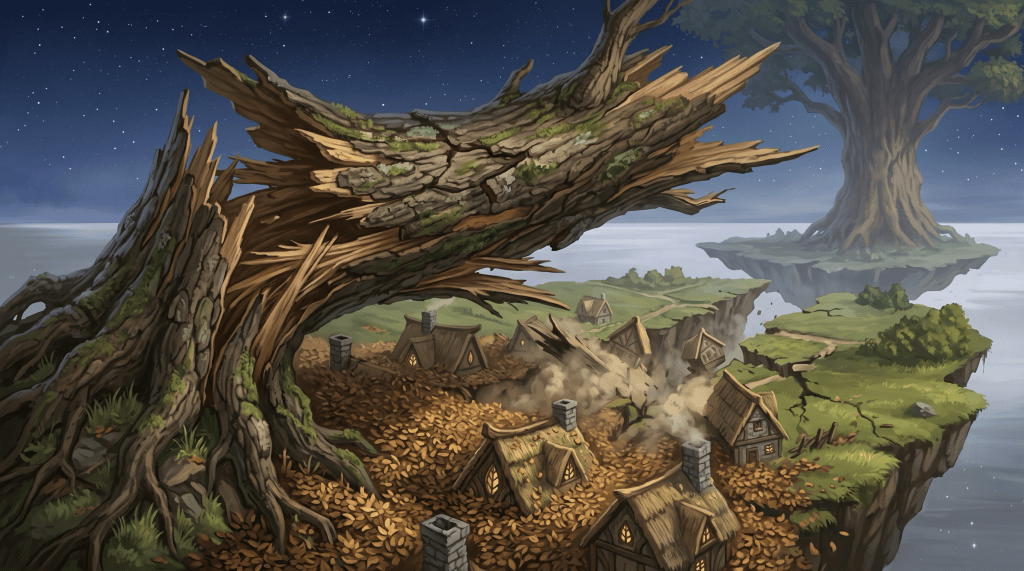
It came off the rear-mast oak — the Aft, Taproot Hamlet’s own, the one that had been greying by inches ever since its dryad was taken from it — and it fell a thousand feet in no hurry at all, all the way down out of the green, and landed on the grass outside somebody’s door.
Then another. Then a dozen. Then a whole bough’s worth, all at once, and then the canopy let go entire — a cascade coming down out of a sky that had been leaves a moment before, dead leaves and dying leaves and blossom all together, so much of it and for so long that the people of Taproot Hamlet came out into the lanes and simply stood in it, looking up, while it buried them. When it finally stopped there were no lanes. No gardens, no wells, no doorsteps — just roofs standing out of a drift of leaf-litter and blossom deep enough to wade through, and the hamlet’s dogs floundering in it, and a silence where a canopy used to move.
Then the trunk cracked.
A Wayfarer Oak does not topple. A thousand feet of living mast with a world hung off its roots does not do anything quickly — it went over slowly, with a deep rumbling creak that everyone on the shard felt through the soles of their feet before they heard it, and under the creak the long tearing note of wood splintering on a scale nobody is built to understand. It took a long time to fall. And it did not fall off Oakhaven; it took Oakhaven with it, ripping the shard open along its own roots as it went. Fields split. Buildings came off their foundations and went sideways into the gap. Lanes ended in air. A third of the world tore loose and went with the tree.
And while it fell — while the shard was tearing along its own roots and a third of Oakhaven was coming away — something under the Main mast stirred.
Not much. The way a sleeper shifts when a door slams elsewhere in the house and does not wake. But it was restless, and it went on being restless long after the noise had stopped, and the ground above it knew.
And then the oak came down on the Void.
It went out past the edge of the shard altogether — a thousand feet of Wayfarer Oak, roots and crown and all, the mast that had sheltered Taproot Hamlet since before anyone now living was born — and it broke the surface of the Silver Void, and lay there. Its reflection lay under it: the whole length of the tree repeated in the silver, just as grey and just as lifeless as the thing casting it. Soil and fence-posts and half a hedgerow came down around it and settled on the surface in a long grey wake.
Then it began to drift — tugged away, gently but relentlessly, out across that flat and endless silver, toward the Tempest’s Maw.
What tore away with it broke up as it went, and that is still out there too: a ring of rubble turning slowly around the place it used to be part of, close enough to recognise. Somebody’s roof. A gate. Half a field, upside down.
The ring is going toward the Maw faster than Oakhaven is. Whatever the storm does to a world, it does it quicker to the pieces. The people of Oakhaven can stand at the new edge and watch their own farmland pull ahead of them, out across the silver, chasing the tree.
On the Fore oak, the last dryad left on the shard — her sister’s tree gone — wept, and did not stop.
The Writ
The Githyanki came before the dust had settled.
A warship first, cresting the horizon behind a plume of flame that stood up into the sky ahead of it.
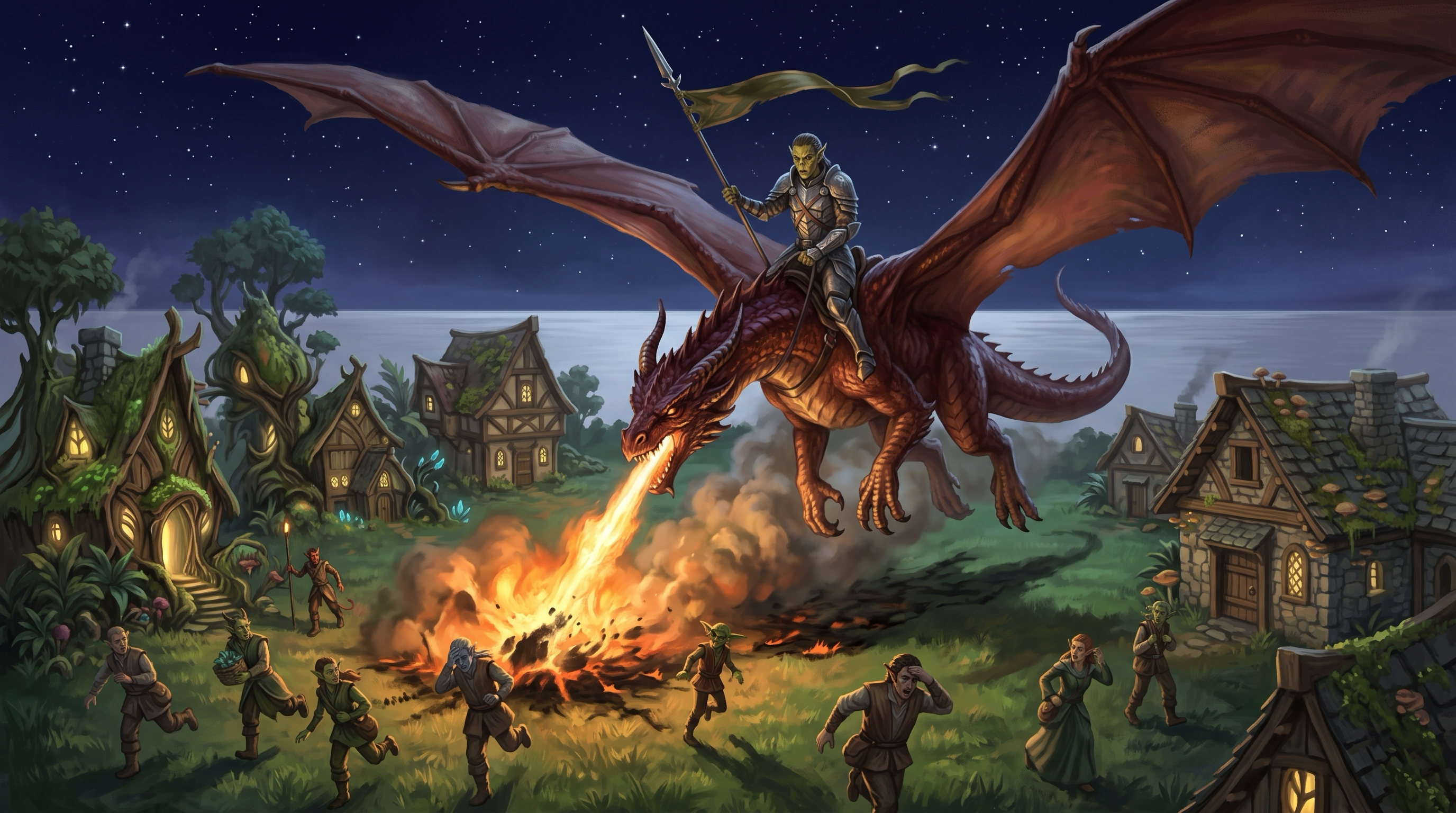
Then, launching off its deck, a dragon. Not a courier’s wyrmling this time: a full adult, scales an iridescent red that threw the light back in colours as it came. And on its back a Githyanki Knight Castellan of the Crusade, armoured, unhurried, holding a long spear aloft with a pennant streaming from it — a banner running out behind them the whole way in.
They did not negotiate. They did not ask for the council. They did not even land.
The dragon swept in low over the main green, under the Main mast and over the whole village at once, and its shadow went across the grass ahead of it, and the heat coming off it scorched the turf black beneath. And from up there, without slowing, the Castellan hurled the spear down — hard enough to bury it upright in the centre of the burn, like a surveyor putting in a stake. Pennant, bond and silver scroll case with it.
There had been a horizon, and then a plume of flame, and then a dragon already overhead. Valena and Drax were moving, and Nana Fogbreath was already up off her rock and out on the green beside them — and by the time any of the three of them reached it, the grass was alight and the spear was in the ground. They were too slow to stop any of it.
They were not too slow to answer it.
The Main mast woke. The great boughs swung down, and the long vines that hang the length of that trunk came with them — all of it moving at once, whipping out across the green after the climbing dragon, reaching to wrap its wings and tangle its legs and haul the whole enormous thing back down out of the air.
Where the vines landed, frost ran out along them as they tightened, and ice went into every wound they opened — crawling in, setting hard, locking the hot flesh around it.
And as they lashed, they grew thorns. Long ones, hooked, budding along the vines in the middle of the strike, opening the dragon up wherever they were dragged across it.
It was one working, and three of them made it, and nobody watching could have told you where one ended and the next began.
Dragon and rider tore free — but not cleanly. The thing that had blotted out the sun on the way in went away on a wounded wing: the beat of it gone wrong, the climb ragged, height coming hard and slow. They laboured away across the silver, losing and regaining the air the whole way, and limped home to their roost in the warship’s rigging.
Which is not nothing. It is also not a victory.
Because on the green, the moment the vines went slack, all three of them came apart.
Whatever that working cost, it was paid at once and in full. They stumbled, and then they went down — grey, shaking, unable to get back up unaided, and helped away afterwards in front of the entire village. Oakhaven has spent a long time assuming, without ever quite saying so, that the people who work its magic are a wall between the shard and whatever comes out of the Void. What the village actually watched that afternoon was the wall spending everything it had on a single dragon, failing to stop it, and having to be carried home.
One of the three was back on her feet noticeably sooner than the others. At the time, with everything else going on, nobody thought to remark on it.
The warship, meanwhile, got on with its work: buoys, laid at even intervals all the way round the shard, until Oakhaven sat at the centre of a ring of Gith markers like a coin in a dish.
And the thing left standing in the burn, once somebody was brave enough to go and read it, was a claim. Oakhaven belongs to the Gith. Not as a prize, not as plunder: as a creche site. A place to breed. What Vael’s sealed mandate said, back when it was still a secret in a cylinder, said again now in open daylight with a signature under it.
Scrolls hold little sway over the fey. Oakhaven looked at the spear standing in the burn, and at the gap where a third of the shard used to be, and barely noticed the case at all.
One guest noticed. Vaelthris, Solicitor of the Eighth Bureau, drew the scroll all the way out and went through it start to finish. She read it twice. Then she stood a while in the scorched grass, saying nothing at all, tapping the silver case slowly with one delicate claw.
Out of the Fire
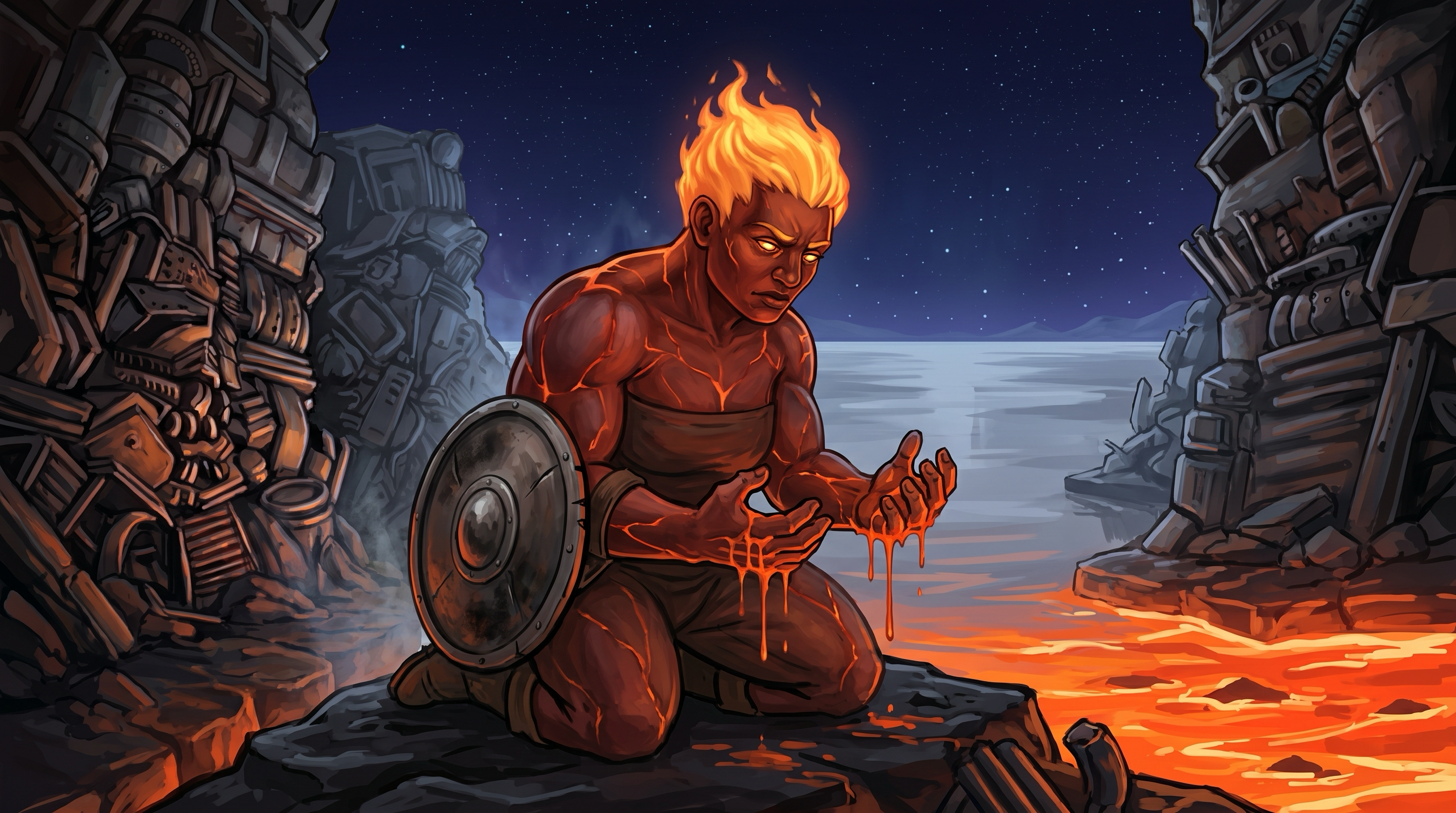
Two thousand miles away, in a scrapyard on a sea of fire, a hand came up out of a lava river and took hold of the bank.
The last anyone saw of Slox, she was locked onto forty feet of armoured scrap-millipede, going down under a black funeral barge into the one part of the Heap too hot for the things that live there.
She came out of it in her own time, steaming, and stood on the bank a while to look at her hands.
Something had changed on the way through. She had gone in bronze — an azer, forge-born, fire in her beard and hammered metal for skin. She came out with the bronze gone and the fire still there, under the skin now, moving with her when she moved: recognisably Slox, and not the same person. The indenture-mark Vespa’s people had put on her had gone with the bronze. She noticed that last, and did not comment on it.
Lindon‘s Hand-Warming Staff is still down there in the Crawler’s hoard. Nobody suggested going back for it, and nobody had to say why.
The Watch had run out of the deep without her and had been at the docks ever since, saying the things people say when they are not going back down. So she walked out on her own, up through country nobody at the Heap has ever crossed twice, and arrived at the dock gate with the ticking still on her and her shield still on her arm.
The Madame’s Price
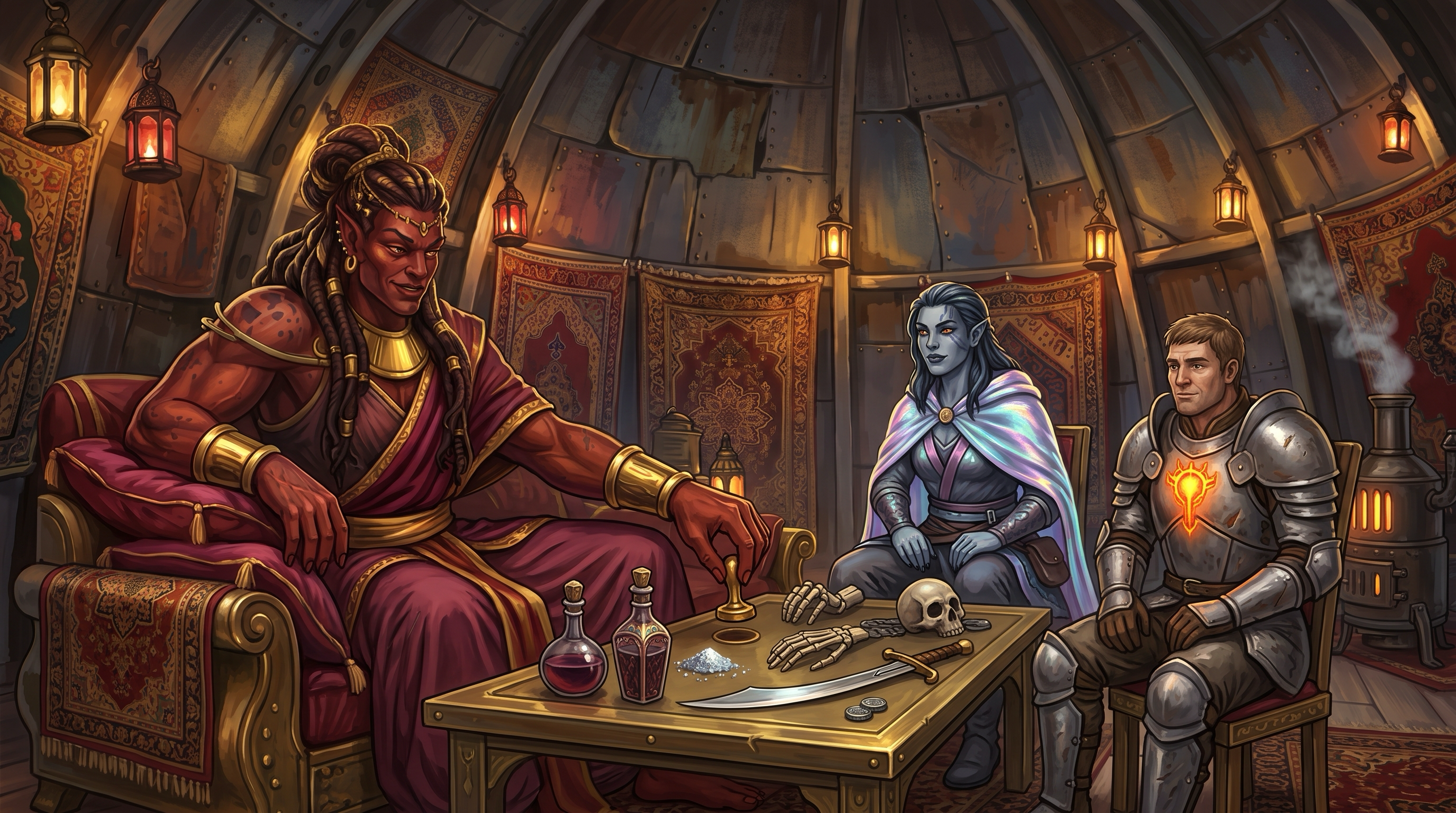
Madame Vespa received them in the tapestried dome as though they had never been in any danger at all, and got down to business, because with Vespa the business is the affection.
What the Watch needed was medicine — real medicine, the kind that puts back what a bad year takes out of a person. What Vespa put on the table was two bottles: ornate things, stoppered and heavier than they looked, each holding a dark liquid that would not sit still — it turned and folded over on itself in the glass whenever the lamplight moved. Solder knew what they were the moment he saw them, and knew what they would be useless without, and it was he who handled that end of the bargaining: powdered diamond, as much of it as he judged the work was going to take.
What Vespa wanted in exchange was information: an up-to-date chart of the Void — where everything is now, this month, a thing very few people in the Void can honestly offer, and the Watch can. Slox threw in a guide’s knowledge of the Heap’s outer reaches, which she has known since she could walk.
And then they cleared out the rest of the Pasha’s estate across her table: the scimitar that sang of old power and that nobody had ever put a name to, the dead man’s skull, his snapped-off hands — and the brass seal-ring off his bier. The little errand she had folded into the deal so lightly, back at the start of all this. A trifle. Sentiment.
She took the ring off the table first, and she took it herself.
Nobody so much as read it for magic before it left their hands.
She paid well and she paid fairly — the two bottles, the powdered diamond, and a battered suit of plate for Solder, who had spent the whole descent keeping everyone alive in a shirt. She released Slox from her indenture without being asked, which nobody expected.
“Ze one who went into my fire,” she said, “is not ze one who came out of it. I do not keep what ze fire has already settled.”
Then she made them an offer, in the way of a merchant who has enjoyed herself. If they ever want work, she has work. And if they can bring her food — anything that grows, anything that was recently alive — she will pay for it in whatever they like. Nothing grows on a sea of fire. It is the one thing in the universe her scrapyard cannot salvage.
Slox, newly free and standing on the only shard she has ever known, walked up the gangplank with them anyway and did not make a speech about it.
They left the Heap on good terms with its ruler, carrying the mask that will become the Winter’s Mask, having handed over a ring that nobody ever looked at twice.
Tink’s Haul
Down on the dock, none of this had reached Tink, who was busy with Foreman Sarn and having the time of his life.
The Heap is the largest collection of broken machinery in the known Void, its foreman is a man who will trade anything not currently holding a building up, and Tink is an artificer with a ship’s hold at his disposal, a line of credit and no impulse control whatsoever. Every time somebody came looking for him, another armful had gone up the gangplank. Cracked pressure housings. A crate of gear-trains with half the teeth gone. Lengths of pipe. Three separate things nobody could identify and Tink could only describe as useful.
By the time the Watch were ready to sail, the deck of the Pale Fang was piled high with junk — lashed down in heaps, filling the waist of the ship, leaving barely a path from rail to rail. The rest of them arrived one at a time to find their warship turned into a floating scrapheap, and not one of them managed the same reaction twice — and Tink weathered every bit of it with the serenity of somebody who has seen what all this is going to be one day and simply lacks the vocabulary to explain it yet.
They sailed for home over-laden and riding low.
Diamond Dust
They also sailed in a hurry, because a message from Master Elizar had caught them at the Heap:
Gith warship blockading Oakhaven. Aft oak lost, a third of the shard with it. Bring the mask. We cannot survive another dragon. Come quickly.
Twenty-five words, and the Watch spent the whole crossing turning them over. Aft oak lost covers a great deal of ground for three words.
The rest of the crossing belonged to Solder, who unstoppered the two bottles, stirred the powdered diamond into them, and went to work on Lindon and Veyer.
Solder’s medicine is not gentle. His god’s power comes through him as heat: it burns what it touches, it seals what it burns, and it leaves the patient wishing very much that it hadn’t. The Watch had seen it the day they first came to the Heap — a young salvager bleeding out on the dock with a sliver of steel through his shoulder, and Solder drawing the metal, setting his holy symbol against the wound and holding it there while it glowed stove-hot and seared the flesh shut, without once breaking off what he was saying.
He did the same here. Twice. On people he had watched come apart in front of him.
And it worked. Lindon has been diminished ever since the Drifting Court took its permanent toll of him — carrying a hole in himself that never closed, going shaky when the blood started, everyone noticing and nobody saying. The plan had been to get him home to Helios and hope. It was in Solder’s voice before he opened the first bottle that nobody was going to have to. Lindon stood up whole, and Veyer stood up with him. It cost a fortune in diamonds, an efreeti’s goodwill, and a night neither of them will describe to anyone.
Then Oakhaven came up over the bow, wearing a ring of rubble and a ring of buoys.
Which Side Was Thin
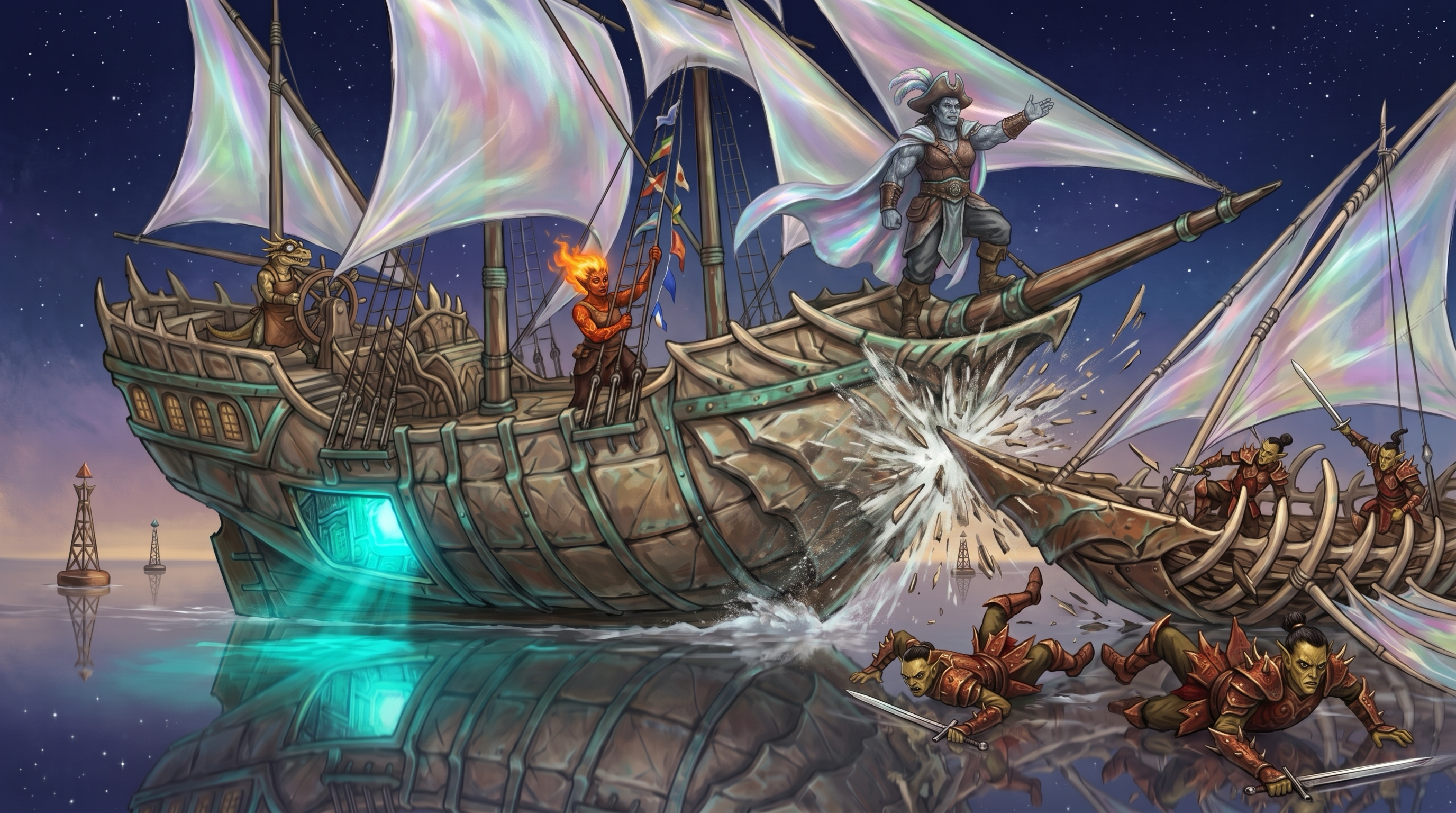
They did not sail straight in. Nobody even suggested it.
They held off at the outskirts and sent Embrath up alone — a red wyrmling in a stolen Githyanki commodore’s hat and a suit of armour made out of a dead mechanical dog, who styles herself this ship’s Commodore and has yet to be talked out of it, and who was absolutely delighted to be asked. She came back full of herself and full of detail, and after a truly heroic quantity of flattery had been paid out to get it, the Watch understood how the blockade actually worked: where the buoys sat, what watched what, and which side of the ring was thin.
The thin side was the wreck side — the quarter where Oakhaven’s own broken fields turn slowly in their ring, picketed by a single skiff. The heavy end of the blockade, the frigate with the adult red dragon dozing in its rigging, was all the way round the other side of the world.
So they went in wearing a costume. Veyer put on Embrath’s commodore’s hat and stood alone and visible at the rail — on her knees behind it, because seven feet of goliath is nobody’s idea of a Githyanki officer, and on her knees she was merely a very large one with somewhere to be. Everyone else got out of sight. And Slox — handed a signal locker and a code book nobody aboard has the key to — ran up a string of flags that meant something to someone once.
There is a particular paralysis that grips a junior officer who has been sent gibberish by a superior, and the skiff sat in it, flags fluttering, while a bone-plated warship came alongside to give them their orders.
At the last possible instant the Pale Fang put her helm over. Tink made the turn — with Veyer’s voice carrying across the deck at exactly the right moment to make an impossible piece of piloting merely very difficult — and the Watch rammed the skiff square in the stern.
Three Gith went overboard from the impact. One of them was the lieutenant, still poring over his signal book.
Boarders
Veyer leaned over the rail and dropped a cloud of daggers on him while he was still out there in the smooth silver surface of the Void, floundering, trying to get his feet under him. It is an unkind thing to do to a man. He had it coming, and there was more to follow.
Slox and Solder went for the skiff.
Neither of them made the jump. Slox slipped as she jumped and caught the enemy’s railing one-handed, hanging over the gap; Solder missed it outright and would have gone into the Void if Slox hadn’t got her other hand into his harness, swung him, and threw him over the rail onto the skiff’s deck, where he landed on a Gith and took the man down with him.
That bought them a foothold and about four seconds. Then it was two of them against four, backed up against the rail of a ship that was not theirs. Slox set about the problem with her shield, trying to bully them over the side one at a time and finding out how well-braced a Githyanki soldier can be — until she lit the shield itself on fire, which solved it. She set a man alight and knocked him backwards off the deck, burning, out onto the silver.
And Solder called up the dead. The astral sea is full of restless things that never finished arriving anywhere, and what he summons is not a choir of angels — it is the wandering ones, and they came aboard with him and set about the Gith with the resentment of the permanently lost. Between the spirits and a burning shield the skiff was theirs.
Empty Hands
Back on the Pale Fang, the lieutenant had got himself off the silver the short way, and arrived on the deck within reach of Veyer with a silver greatsword, two crew and a great deal to prove.
He hurt her badly. He came out of the dark and opened up a goliath that very few things have ever managed to lay a hand on.
Lindon answered with cold moonlight, and the two crewmen fell into it — held there in a column of cold white light while it did what that light always does, and took the flesh off them.
And Veyer, bleeding, made the greatsword too hot to hold.
He tried to hold it. He genuinely tried — you can respect a man for the attempt — and then the sword hit the deck and rang.
And then he went after it. Again, and again: stooping for a prized blade lying white-hot on the planking, closing his hand on it, snatching the hand back, while the fight carried on over the top of him and his own crew watched their commander lose an argument with a sword. He never did get it back.
So he stood there in front of his enemies and his own command with empty burned hands. What followed was a long and inventive exchange of insults in two languages, while a Githyanki lieutenant fought a bard with his bare fists out of pure wounded pride.
He lost that too. When it had gone past any arguing, he reached to his belt, pulled a flare, and fired it straight up.
It was answered from the far side of the world. No sound — nothing carries that far out here — just a light: a bright bloom of fire launched up into the star-filled sky above the frigate, small with distance, and unmistakable.
It ended not long after that. Slox picked Solder up again, because it had worked the first time, and bowled him — cleric, restless dead and all — across the deck into the knot of Gith still standing over a very battered Veyer and Lindon. The spirits did the rest.
What Came Round the World
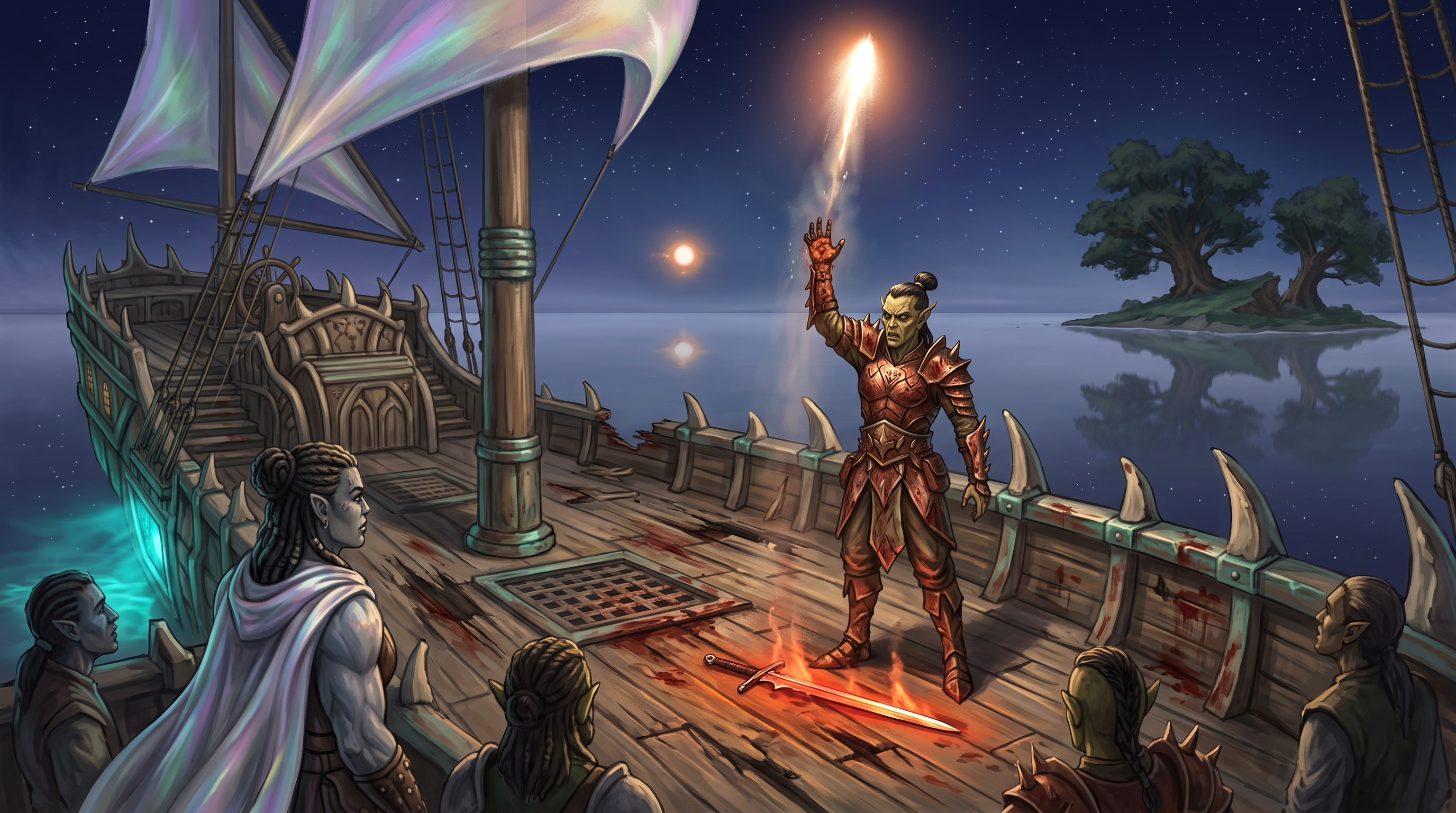
They stood on a wrecked deck alongside a captured skiff, alongside the ring of rubble that used to be a third of their home, and watched the far horizon.
The red dragon lifted off the distant warship. It did not climb to cross over the shard. It came around — the long way, round the curve of Oakhaven, with the flat certainty of a thing that has never once had to hurry, and knew exactly where the Pale Fang would be by the time it got there.


Leave a Reply