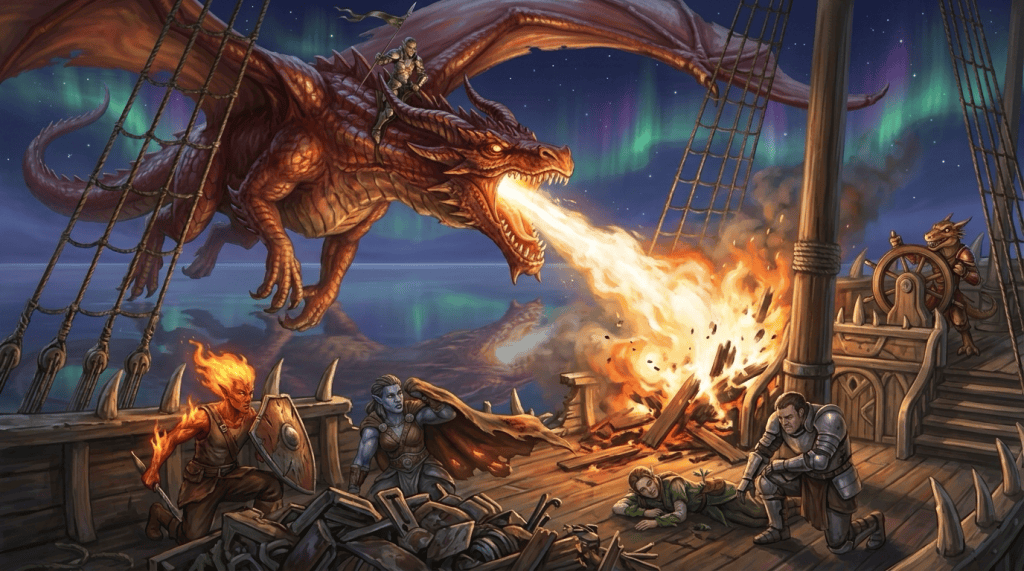
It came round Oakhaven with no hurry in it at all.
It did not climb. It did not cross the shard, which would have been quicker. It came around — low, following the curve of the edge, its reflection sliding along under it on the silver — because the short way went over the Main mast, and under the Main mast that morning three old fey had put frost and thorn through its wings.
The Watch worked that out standing on a wrecked deck with their bowsprit still buried in a captured Gith skiff. Knight Castellan Ir’venh of the Crusade, on the adult red Vestrath, was not going to cross the tree line. The great oak’s boughs were the finish line. Everything between here and there was open water, and they were not yet moving.
The dragon reached them while the two hulls were still fouled together. From four hundred feet up, what Ir’venh could see was two Gith vessels that had run into each other, and a commodore’s hat at the rail of one of them.
So Veyer wore it, and knelt behind the rail, and was a very large Githyanki officer with a great deal to say — and for as long as she kept saying it, Ir’venh kept listening. Not long. Long enough. The Pale Fang worked herself free of the wreckage, and the moment she was clear Tink put her bow for the buoy line and ran.
Behind them, no longer confused, the dragon came on.
The Line
The buoy line lay between them and the trees: Gith markers at even intervals all the way round the shard, humming quietly to themselves.
Then the markers noticed them.
The hum climbed — not in the air, in their heads. It rose behind the eyes until it was a headache and kept rising, and then it stopped being a hum and became a question: a challenge, in a language nobody aboard has, expecting an answer nobody aboard could give.
They did not answer it. There was no time to answer it and no time to look at what was asking. They threw their own magic at the nearest marker and suppressed whatever made it work — not broken, just quiet, for the few seconds a ship needs — and went through the gap while the question was still trying to remember itself.
Behind them the marker came back up, and hummed, and the ring was whole again.
Something Moving in the Ring
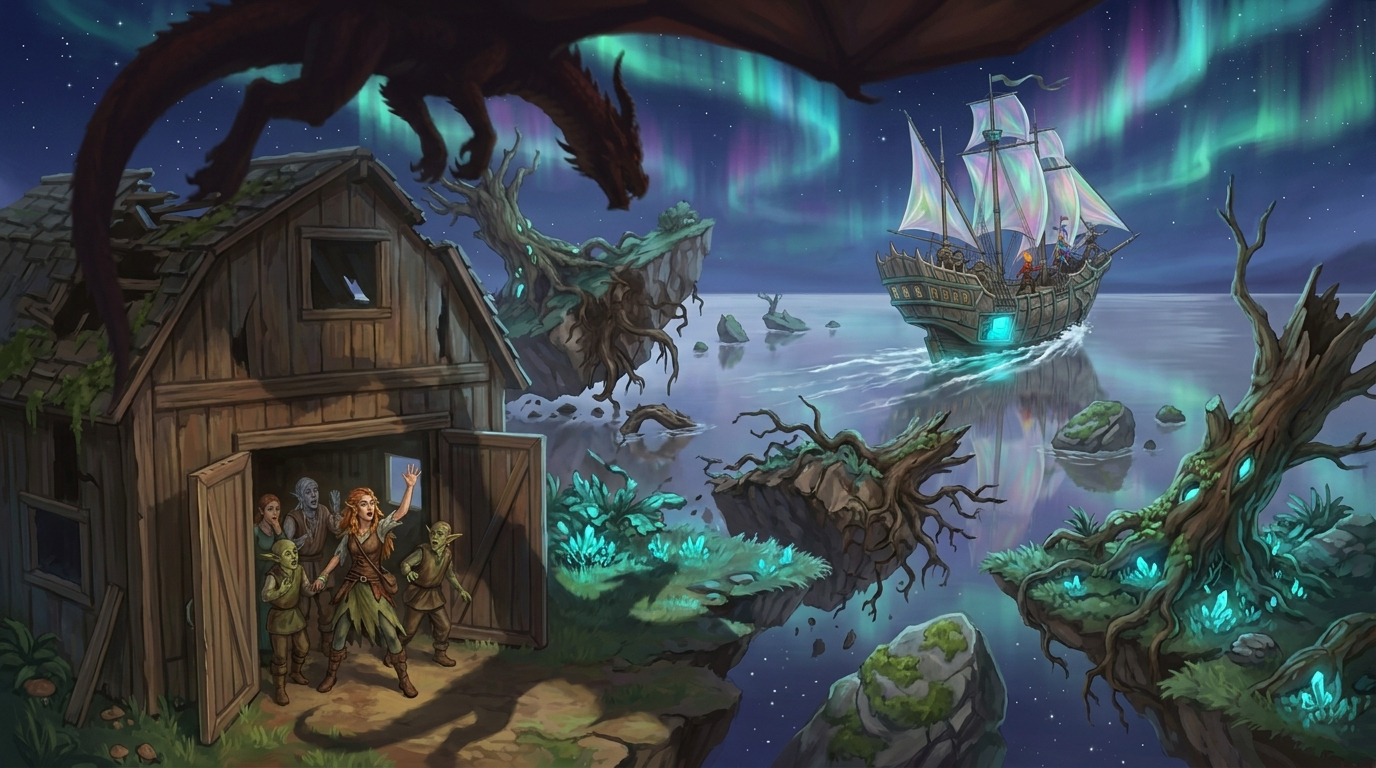
Past the line lay the ring: everything the Aft oak had torn off Oakhaven, turning slowly around the place it used to be — and being drawn away from it, all of it, toward the Tempest’s Maw, so that it trailed off the shard like the loose tail of a comet. A barn, revolving. A gate, still shut. A miles-wide haze of dry leaf and chaff.
And in the haze, figures. Moving.
Talia — the Autumn Eladrin who had been up the Aft oak’s lines when the canopy let go, whose name the rigging crews had been saying before they climbed ever since — was alive. Hiding in the remains of a barn with a handful of Taproot Hamlet’s people around her, waving at the only ship in the sky.
The Watch saw her. So did the dragon.
There was no getting to her, not with Vestrath a wingbeat behind. There was only one thing on that deck that could change what the dragon was about to do, and the Watch did it: they shouted at it. All of them, at the rail, yelling at an adult red dragon and shooting at it with everything that would reach. Anything to make it look at them instead.
It looked at them. It came round in a long turn and opened its mouth, a deep amber glow forming in its throat — and the deck went white.
Tink’s junk saved them. All that scrap from the Heap — the housings and gear-trains and pipe, lashed in heaps the length of the waist, the stuff everyone had wanted thrown over the side — was the only cover on the ship. It was not enough. Lindon and Veyer were both badly burned, and the rigging above them caught. But Tink got the ship’s shield up, at a cost to her core, and Solder was among the burned with his hands already glowing, doing what Solder’s medicine does, which is hurt and work. The Pale Fang came out of it scorched and nobody dead.
And something on the deck didn’t cool down along with the rest of the scrap.
One large hunk of stone in Tink’s junk had taken the fire wrong. Runes flashed briefly across it — a script none of them knew — and a wisp of ethereal energy sputtered along one edge for a few seconds before it cooled with everything else. It was lying against the rail next to Slox. She looked at it. There was no time to look properly.
Out in the haze, Talia and her people were still in their barn, watching the dragon go after the ship instead of them.
The Cathedral
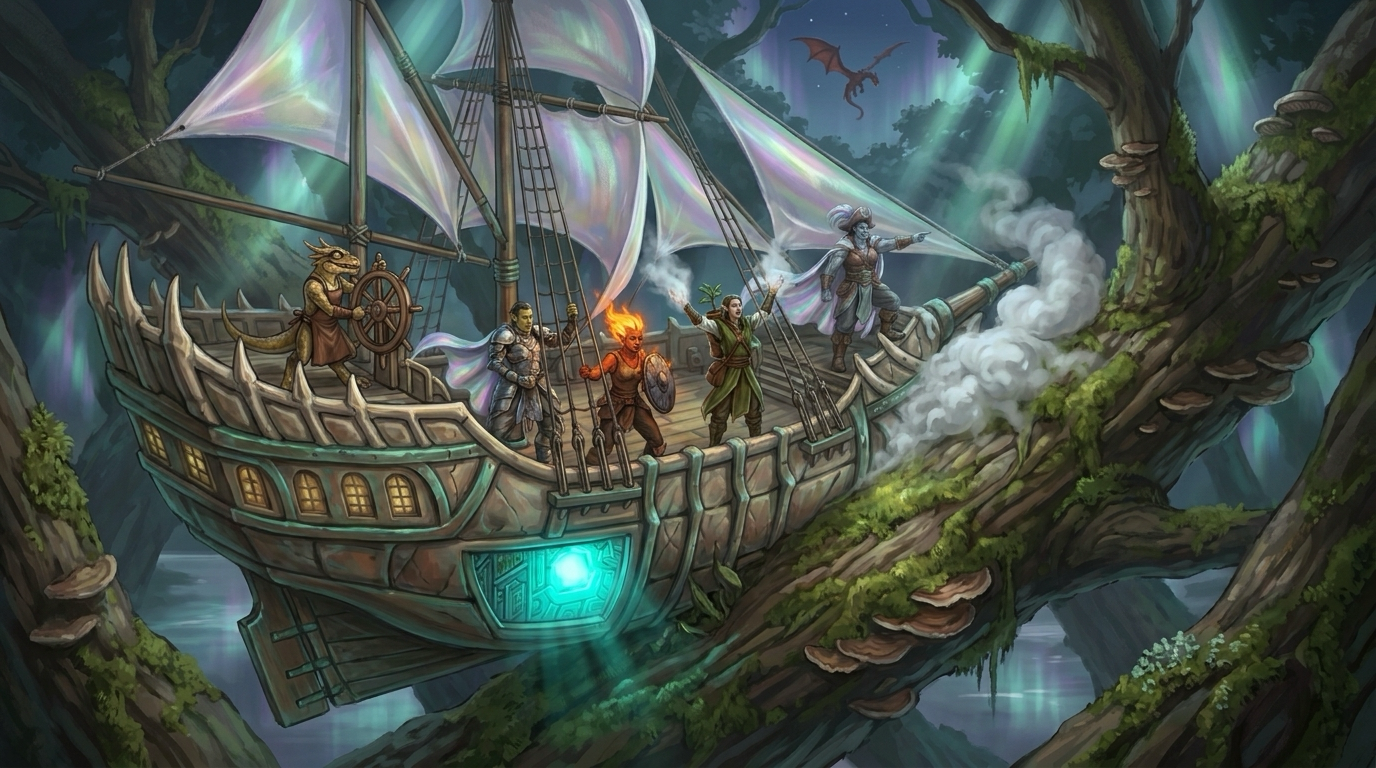
The fallen oak lay across their path like a wrecked cathedral — a thousand feet of Wayfarer Oak on the surface of the Void, its grey reflection under it, turning so slowly you could only tell by the boughs.
Tink put the ship into it at the bow.
The canopy is a mile of interlocked wood and the gaps were not made for a warship. He threaded her through anyway. Lindon put a fog cloud up through the branches behind them, and the strafe lining up on the stern found only fog and timber. The Watch fired back through the gaps — small, half-blind shots at a shape moving over the canopy — and the dragon would not come in after them. It circled. It waited.
They went the length of the tree and came out through the rootball into open sky — the same roots that had torn a third of Oakhaven away when they went.
The Torn Edge
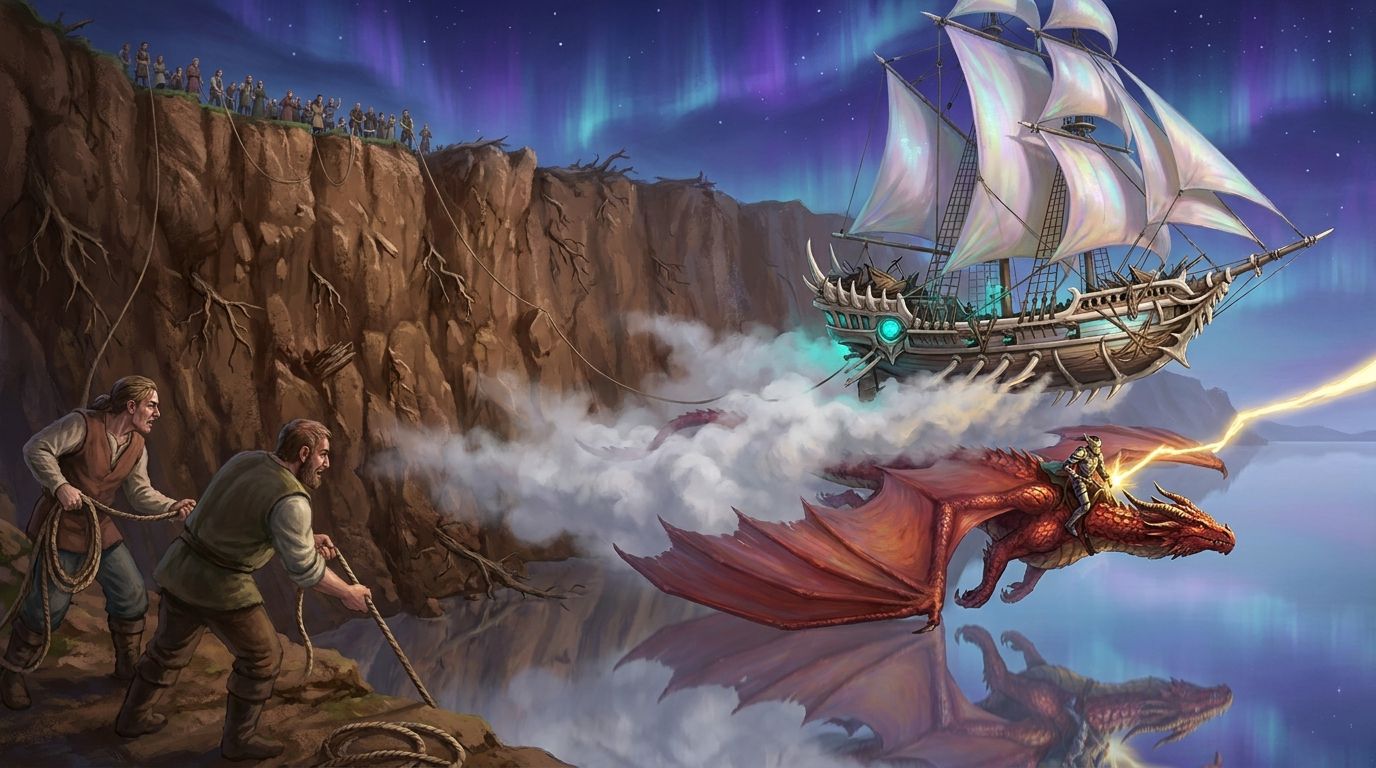
And there was home. Not the shape it used to be: where the fields had run out to the Aft oak there was a cliff now, raw and new, and along the top of it, in the open, stood fifty people of Oakhaven with lines in their hands.
Vestrath came round for one more pass. It did not much matter to Vestrath whether that pass went into a warship or into fifty people on a cliff.
So the Watch made it matter. They opened up on the dragon again, everything at once, to drag it off the shore and onto the deck — and it was Solder’s shot that went home, a bolt of guiding light into the flank of an adult red. It came for the ship.
Lindon’s fog was already going up and Tink was already turning into it. The dragon lost the Pale Fang in the cloud for the half-second it needed, came through where she had been, and found her above it — passing directly under the hull, close enough to touch. The Watch threw everything they had down onto its back as it went by: spells, and anything pointy they could lay hands on.
Then the boughs of the Main oak were over them, and Vestrath held off one wingbeat short of the leaves, and would not come further. Ir’venh turned in the saddle and watched them the whole slow way round as he banked away.
Below the bow, people were running down to the new cliff with lines.
The Empty Green
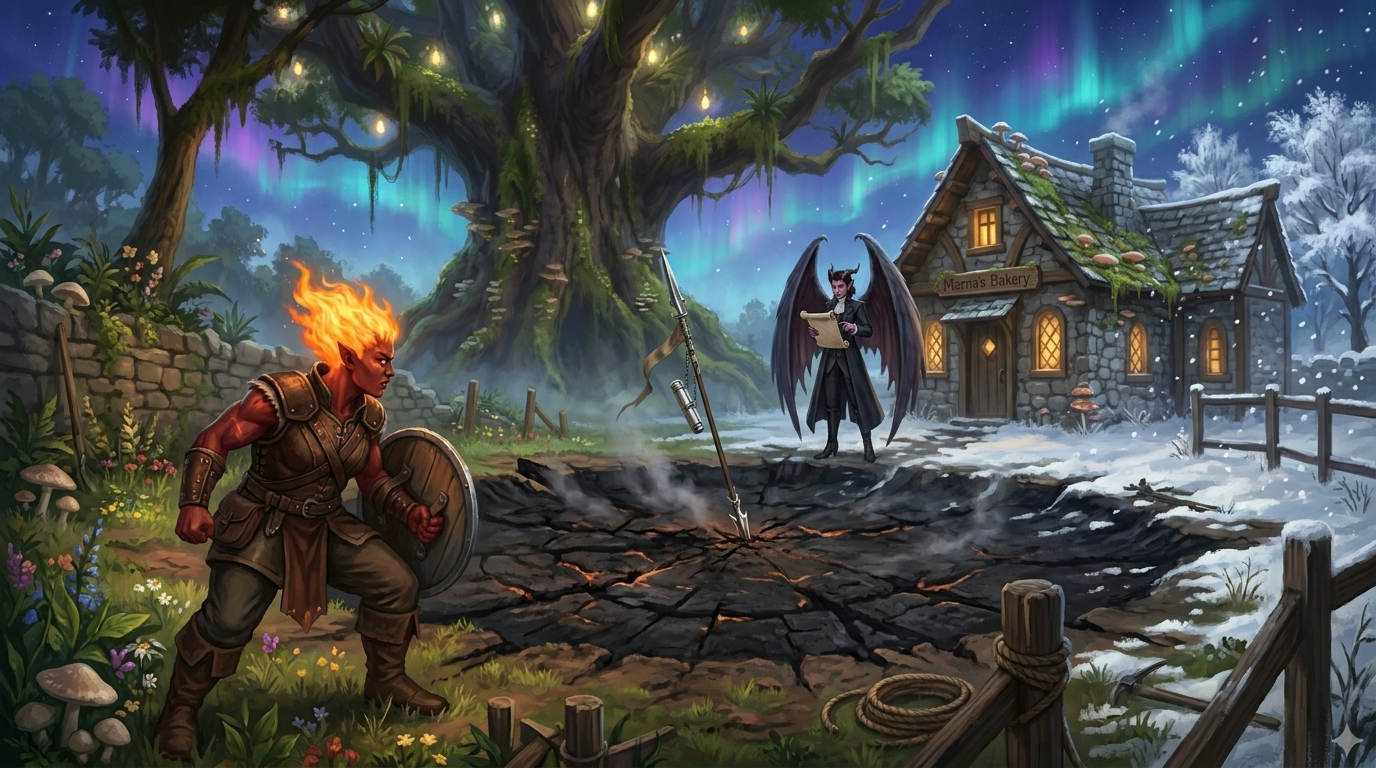
Valena and Drax were nowhere. The working that had wounded the dragon had cost them everything, and two days on they were still abed. It was Master Elizar who came down to the ships, and Elizar who told the Watch what the shard needed, how long they had, and what was coming.
It had rained — the first rain since the tree fell. But something had gone wrong after it. The sky over Oakhaven had turned angry, and it had stopped being one sky: snow on the orchard and full summer on the field beside it, a lane warm at one end and white at the other, the line between them not moving for the wind.
With the elders down, Nana Fogbreath had stepped into the gap — up off her rock and in the lanes, organising work parties, allotting hands, telling people where to dig. She did it well and she did it kindly. Nobody asked what authority she was doing it on. There was nobody upright to ask.
The spear still stood in the burn on the green, exactly where the Castellan had thrown it. The fey would not go within twenty feet of it.
Slox went closer — in stages, a few steps and a stop, wary as a cat — until she was near enough to read the pennant, and a voice behind her asked, pleasantly, whether she was interested in the drafting.
Vaelthris, Solicitor of the Eighth Bureau, had spent a great deal of the past two days with that writ, and what she wanted to talk about, to the one member of the Watch who had dared approach it, was the quality of the thing — its language, its structure, the care in the clauses. Very good drafting indeed, she said.
She had also reached the end of her patience. The council would take the Bureau’s protection now, or she would leave. And under the connoisseurship the Watch caught something else: she was concerned. Not by the dragon — by the paperwork. There was a second claim on Oakhaven now, staked in the middle of the green with a pennant on it, and a Solicitor of the Eighth Bureau does not stay on a property with two claims on it to argue the second. She had, more or less, already decided.
They saw the queue for her before they saw her. Villagers of Oakhaven lined up in the lane outside the guest cottage, quiet, some with children, waiting their turn to ask a devil for a way off their own world.
The Watch looked at that for a while. Then they went to see about what needed doing.
Back Out
They went back for Talia.
Nobody asked them to. The barn she was hiding in was out past the blockade in the one part of the ring the Gith watched. They waited until the dragon was on the far side of the world, took the Pale Fang back out through the line the same way, and found her where they had left her — Talia, and the few of Taproot’s people who had been on the ring with her when the oak went.
They got everyone aboard. And Vestrath found them on the way back.
The run home was very fine indeed. A ship already scorched, riding low with refugees, outrun by the thing behind her, and Moonlit Cove coming up a great deal slower than anyone wanted. They made it with nothing to spare, into the Main oak’s reach, and the dragon peeled away one more time at the edge of the leaves.
The rigging crews had been saying Talia’s name before they climbed. Now she was standing on the dock.
The Burial
Taproot Hamlet is not a ruin. It is a drift — a lake of dead leaf and blossom, chest-deep, that came down all at once when the Aft oak let go and buried the lanes and the wells and the people who had come out to look up at it. The survivors call it the burial.
The Watch went into it with the digging parties. Slow work, and filthy, and every hour turns something up. Some of what it turned up was alive.
Old Man’s Breath
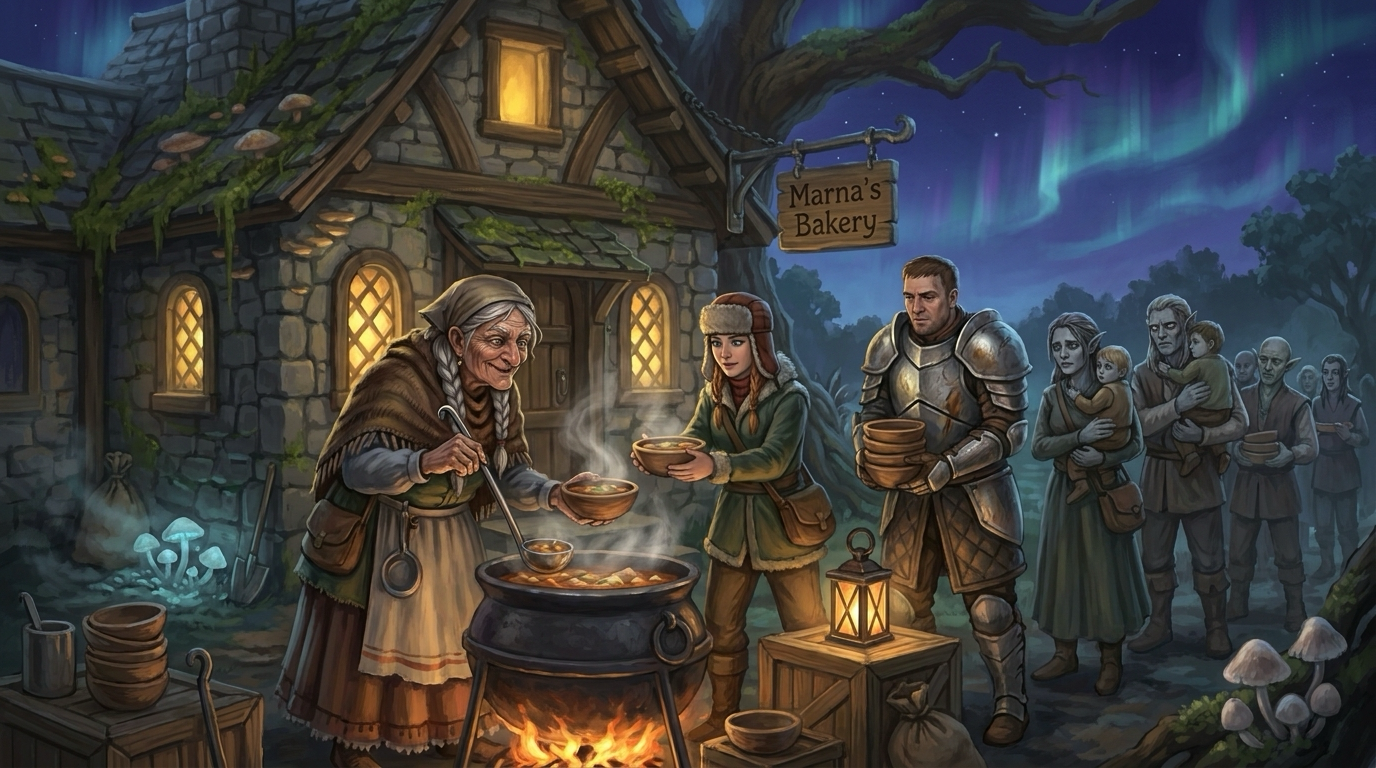
There was soup outside Marna‘s bakery — Solder at the pot with Marna, doing the cooking, Cloe handing out the bowls, and Nana ladling. Mushroom soup. She was the only person on the shard who did not look tired.
“There you are. Been wondering when. Sit down, the pair of you, you look like the wrong end of a week.”
She asked for nothing. When the ritual came up, she was reassuring: her part was in hand. And when the list came up — the reagents she had given Veyer at the very start, to prove a connection to the void — she was warm about that too. The coral, delivered. The chitin, delivered. And the vial of pure vacuum-frost, the cold of the open Void itself, that had never been fetched because there was nowhere within a month’s sailing to fetch it from —
“Never mind, dear. I’ve something that’ll do.”
She had it ready. In the cold, dark, shaded corner of Hushing Rock she had been growing a fungus: pale, close-capped, breathing a faint fog off itself in the still air like an old man’s breath on a winter morning. Old Man’s Breath, she called it. It holds a little of the Void’s stillness. It would do very well for the still point of the working.
It only wanted squeezing.
Veyer and Lindon did it. The stuff inside is cold — cold the way the open Void is cold, enough to bite the hands that handle it — so Lindon warded them both, and they took hold of the thing between them and pressed the essence out into the vessel she gave them. Carefully. Kindly. The way you would do anything for an old woman who had asked for help.
She thanked them very much.
The Cold Forge
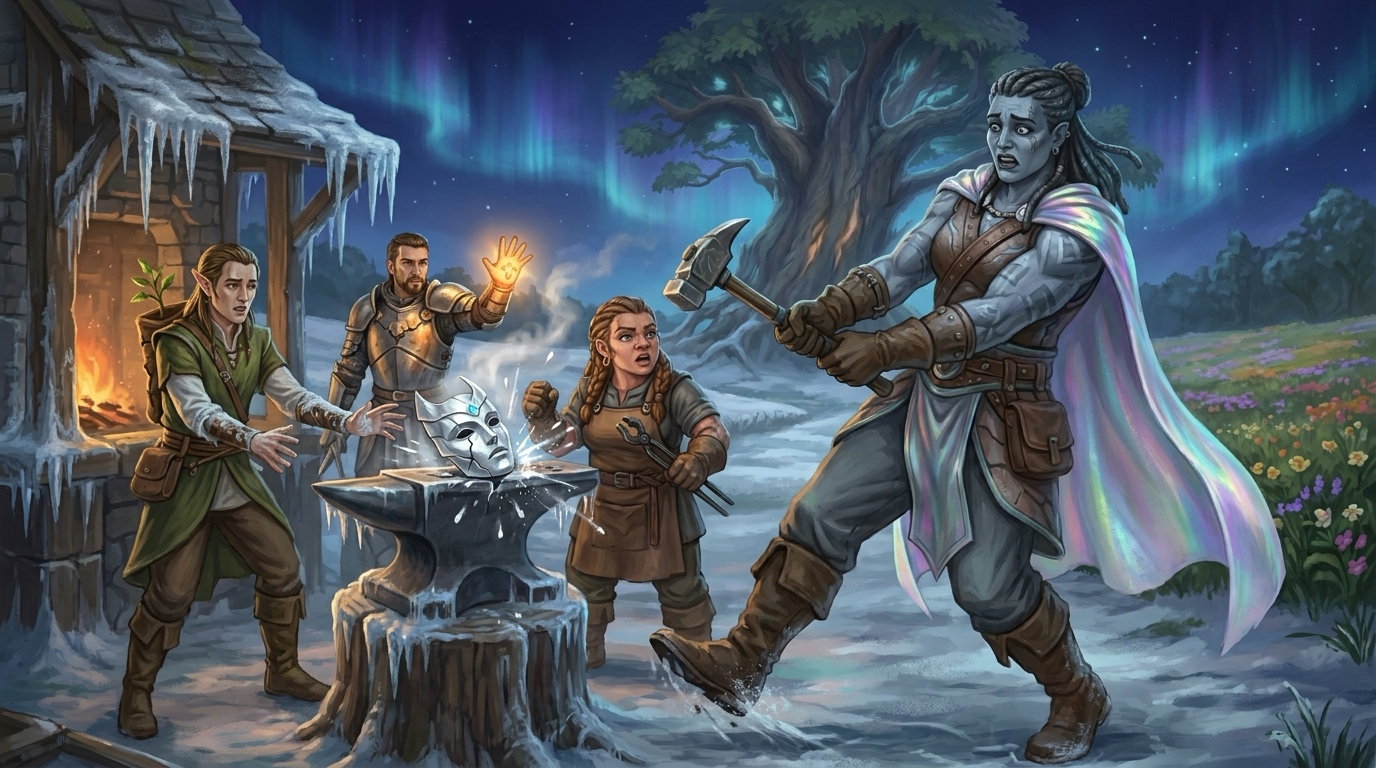
There is no cold on Oakhaven — not the kind you can forge with — and the Iron Forge had sailed out of reach a week ago.
So Brunna built one. Out of Tink’s junk: the cracked housings, the gear-trains with half their teeth, the things nobody could name — laid out on the green and found to be, piece by improbable piece, exactly the kit she needed. She built it over a day and a night while the Watch hauled and held and fetched, and when it was built Lindon stood over it with his druid’s hands out and kept it cold — pulling the frost up into the housings and holding it there against the heat of the metal, for hours, the whole time she worked.
On the block lay the mirror-platinum death-mask of Pasha Sohrab, and beside it the thing they had decanted from the Drifting Court. Brunna worked the one into the other. The platinum took the cold and took the shadow and began to become a different face: a frozen tear, a crown of frost-fern and thorn. Fey winter, in metal.
The last stroke was Veyer’s — the blow that sets the working, struck by someone with a stake in it. Everyone at the forge put what they had behind her: Lindon’s totem, Solder’s guidance, her own bardic nerve.
She swung, and the hammer turned in her hand, and it came down wrong.
The Mask is made. It is the Winter’s Mask, and it will serve. But across the mirror-smooth face of it, brow to jaw, there is a scar — a single bright flaw in the platinum that everyone who looks at the thing will see.
Nobody has to be told it went wrong.
Marna
Marna found the Watch at the bakery, flour on her hands, voice under control.
She was not leaving. She had said as much to the queue outside Vaelthris’s cottage by not joining it: not at that price. Not her soul. She believed in the Watch.
But Cloe had a part in the working — Nana had said so, warmly, as though it were a gift — and Marna asked the Watch for the only thing she asked them for in all of this: keep her daughter out of the ritual, and away from Nana Fogbreath.
Nana, for her part, could not have been more attentive to the girl. She kept Cloe close, and fed, and busy, and near. She was, everyone agreed, very protective.
The Boundary
By the second evening the mushrooms were everywhere.
Pale, close-capped, breathing their faint fog — round the base of the walls, along the ditches, at the foot of the stakes, creeping at the edges of things. Nana had sent them out. With the elders down, she had gone round the work parties and seen to it that Old Man’s Breath was sprinkled along the whole boundary of Oakhaven — for the working, she said; so the island would know where it ended.
It sounded sensible. Nobody questioned it.
Forty Hours
Two days, and this is what they bought.
A Mask with a scar on it. A forge on the green. Talia home, and the ones who came back with her, and a handful of Taproot’s people dug living out of the burial. A ship that is damaged and can be mended. A writ that has been read, and a spear that nobody has pulled.
The sky over Oakhaven is in pieces — winter on the orchard, summer on the next field, the line between them standing still in the wind. The mushrooms are round the edge of everything. Valena and Drax are on their feet at last, grey and thin. The Crown is ready, and the scarred Mask, and the still point is in Nana’s keeping.
And out past the buoys, the first hulls of the Gith fleet are settling into line — unhurried, in order, the way you park equipment. More behind them. Ir’venh’s writ said what they were coming to do. Now they are coming to do it.
 Sailing the Silver Void
Leave a comment