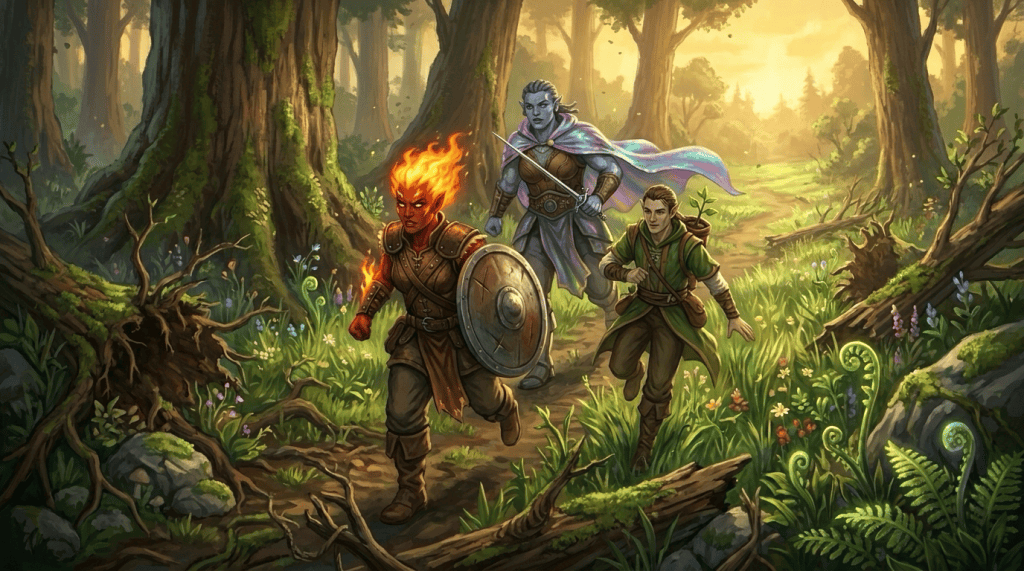
They split in front of the Foremast.
Somebody had to take the dragon’s head home. There is no arguing with a dragon’s head, and after three days of being told what the Gith intended for Oakhaven the village was owed something it could put its hands on. Solder found one of the great gossamer snails that haul for the hamlets, had the head lifted onto its shell, and set off for the village beside it at a snail’s pace, with the light going and a long way still to walk. He would be in Oakhaven when the fleet came down.
The other three ran toward the Main oak, and the Gith stealing what lived beneath it.
Round the back of the great trunk, amongst the twisted roots, they found the forest flattened and piles of loose earth heaped round the entrance to a tunnel. It had not been dug. Something big had cut through the packed earth and roots, leaving jagged claw marks.
Whatever it was, it had gone off toward Bramble Bay with the Gith, and the Gith had gone with the thing that belonged under this tree.
They did not need to track it. The trail was plain: uprooted trees and flattened undergrowth, punctuated by an over-abundance of new growth — brambles, spring flowers, ferns, grass standing a foot high where that morning there had been bare earth. Everywhere the fragment had passed, the forest had answered it. The brambles were still coming, growing visibly as the Watch ran past, the way a thing grows when you watch it for an hour and are fairly sure you saw it move. It ran straight through the wood, a green wake over a trail of wreckage, and at the end of it was the thing that had left it.
Lindon knew what they were chasing. He had knelt in front of it once, in the dark under the Main oak with Kaymos beside him, and been looked at by it, and come away marked. The Green Lord, dreaming. What the Gith were carrying down to the bay on a disk of nothing was a piece of Oberon, and his forest knew it, and was reaching after it the whole way.
The Trail
The Gith had given some thought to being followed.
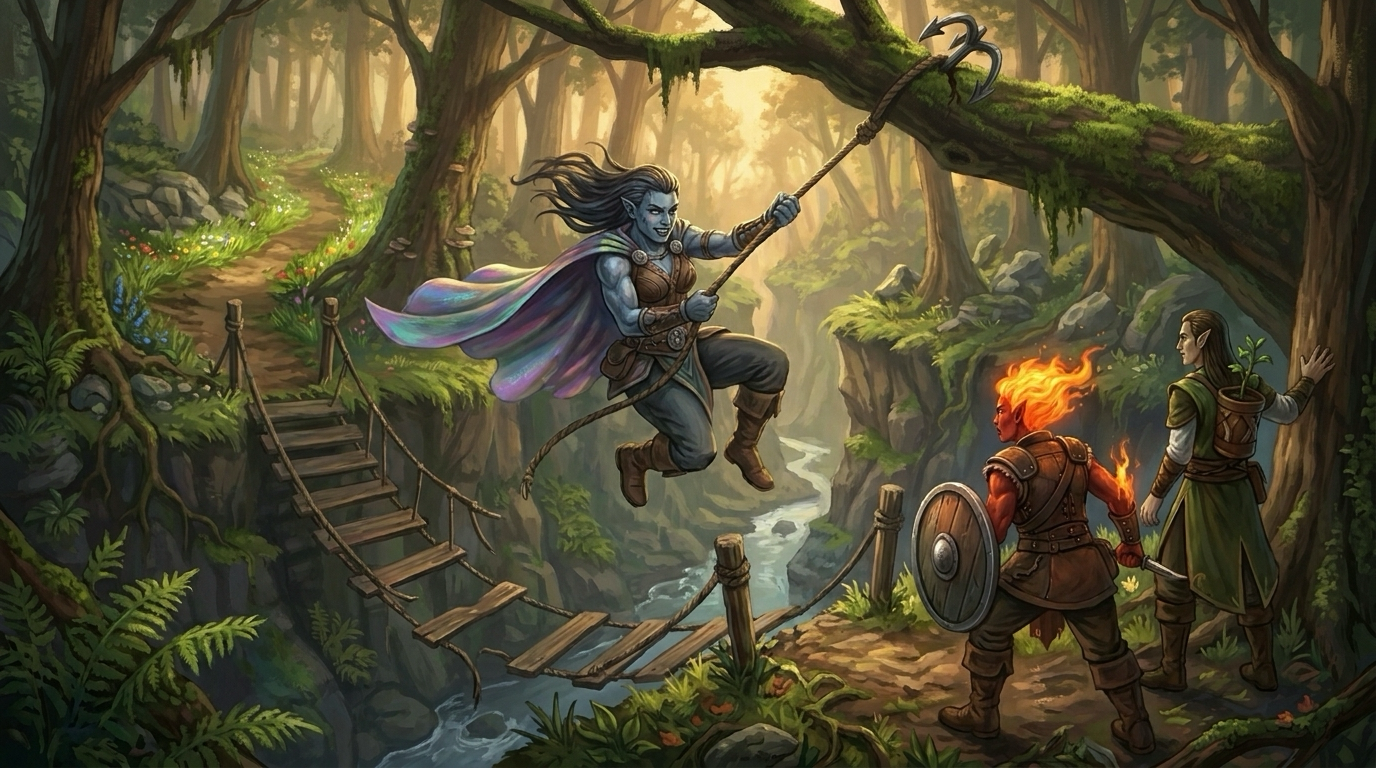
There had been a bridge over the ravine on the bay path. There were now two posts and a great deal of air. Veyer looked at the gap for about as long as it took to take the grappling hook off her belt, and threw it up into the boughs, where it bit. One line, one goliath’s weight to prove it, and then the three of them swung across the ravine one after another like children on a rope over a river, and landed running.
A little further on, Slox went down.
There was nothing there. A stretch of path exactly like the stretch before it, the green wake running down the middle, and then Slox was on her knees in it with blood coming through her trousers in a dozen places and her head turning to find whatever had done it. Nothing had moved. Nothing was there to see. It is a particular kind of indignity, to be badly hurt by nothing at all, and she took it in silence.
Lindon saw it, because he had done something like it himself. Where he would have grown thorns, the Gith had conjured invisible spines: shards and needles like splintered bone, pushed up through the ground, laid across the trail behind them for whoever came next. He knew the shape of the working if not the hand that had made it, and once it was named it could be gone round. They left the path and went through the trees instead, and the trees let them.
They were quick. Quicker than the Gith had reckoned on, because they came over a rise and there, down the long slope of the path ahead of them, was the column: a knot of armoured Githyanki moving at a walk, a warm glow floating waist-high in the middle of them, and alongside, half out of the ground and shouldering the earth aside as it went, something the size of a hay-cart with a shell on its back and a mouth at the front.
The Eggs
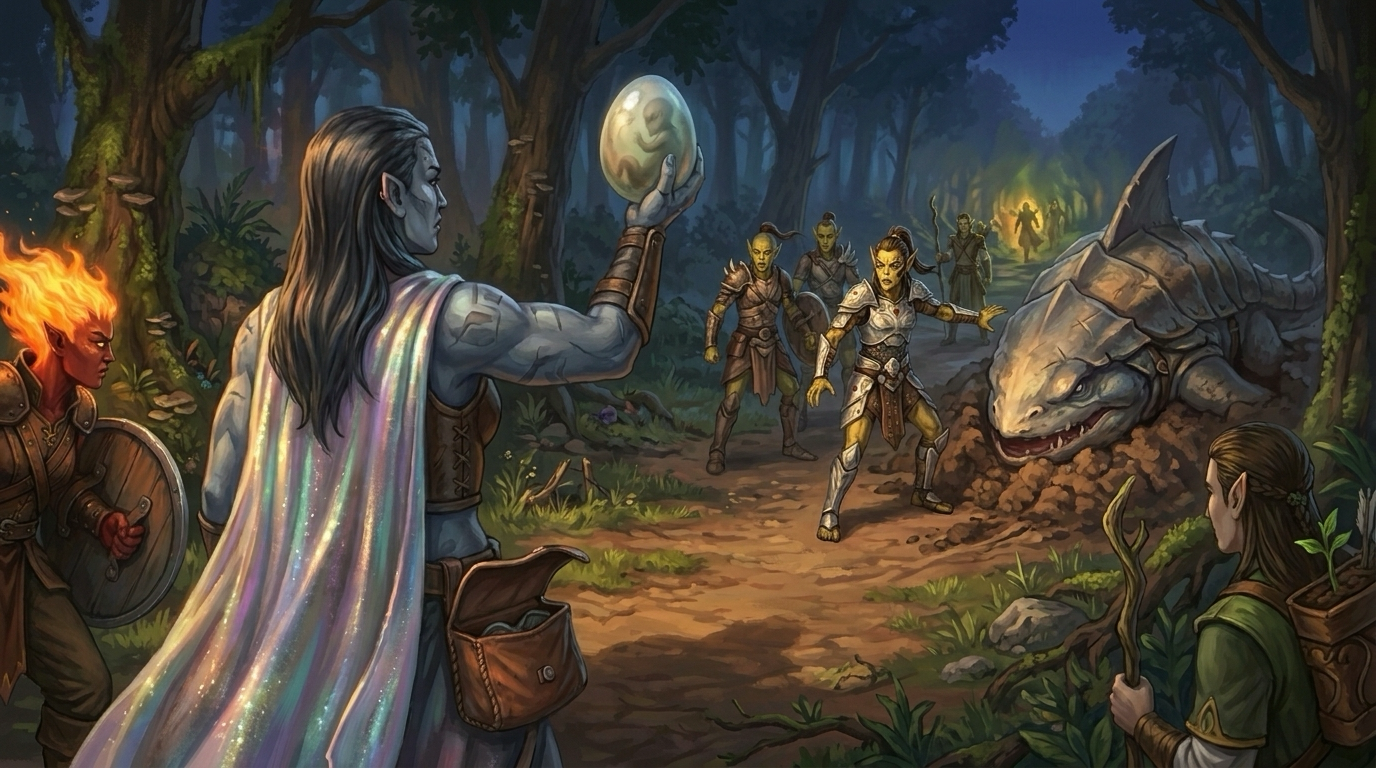
The Gith turned. The thing beside them turned with them, and one of the Gith stood a little apart from the rest with a hand held out toward it, the way a man holds a dog that is not his and that he does not entirely trust.
Veyer walked out into the open and put a hand into her bag.
When it came out it was holding an egg. Grey-green and leathery, the size of a melon, with the dim curled shape inside that every Gith on that path knew the look of better than they knew their own faces. She had gone to the nursery with a hammer, and a few of the eggs had gone into the bag instead, and nobody had asked her why. Nobody needed to now.
She held it up where the whole column could see it.
Nobody moved. For as long as that lasted the thing with the shell crouched where it had been told to crouch, and the Gith with his hand out did not close it, and the Watch stood in the open with the bolts of three heavy crossbows pointed at them and got their breath back. It was a fair trade, for the time it bought. It bought the Gith time too. Behind the line, without any order anyone heard, the warm glow moved off down the path toward the bay, and the warriors round it went with it, until only the handler and his beast were left standing between the Watch and the water.
Then the handler closed his hand.
Veyer looked at him, and at the egg, and dropped it on the stones of the path, and put her boot through it.
The Bulette
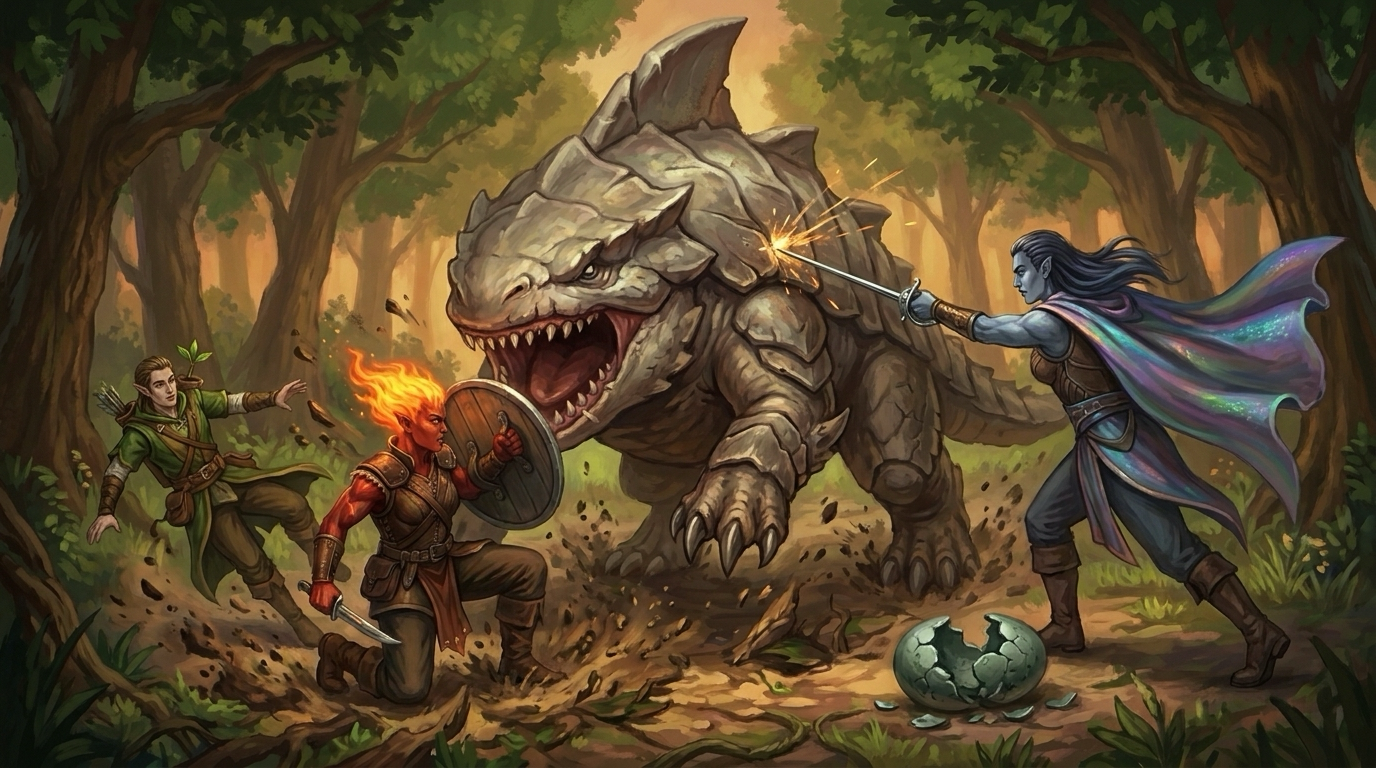
It came down the path at them half under the ground and half over it, the trail heaving up ahead of it in a bow-wave of black earth and torn roots, and at the last moment it left the ground altogether and came down on Lindon and Slox together.
Veyer went in with the rapier. A rapier is a fine thing against a man. Against a shell you can hear it skate.
Slox did it the other way. She got her feet under her with the thing’s weight still on her and simply hit it — shield, blade, shield, blade — blow after blow without a pause between them, until the creature stopped trying to eat her and started, visibly, trying to understand what was happening to it.
It was not enough to kill it. It was enough, because Lindon had found the man holding its leash.
He made the handler’s armour hot. The breastplate began to glow, dull red and then brighter, and the Gith forgot the bulette entirely and went at the buckles with both hands, scrabbling, and could not get them undone. He turned and ran for the sea.
The bulette felt the leash go. It looked at the three of them, and made the decision that any sensible animal makes when the ground is full of easier things. It went back into the earth and away into the forest.
Bramble Bay
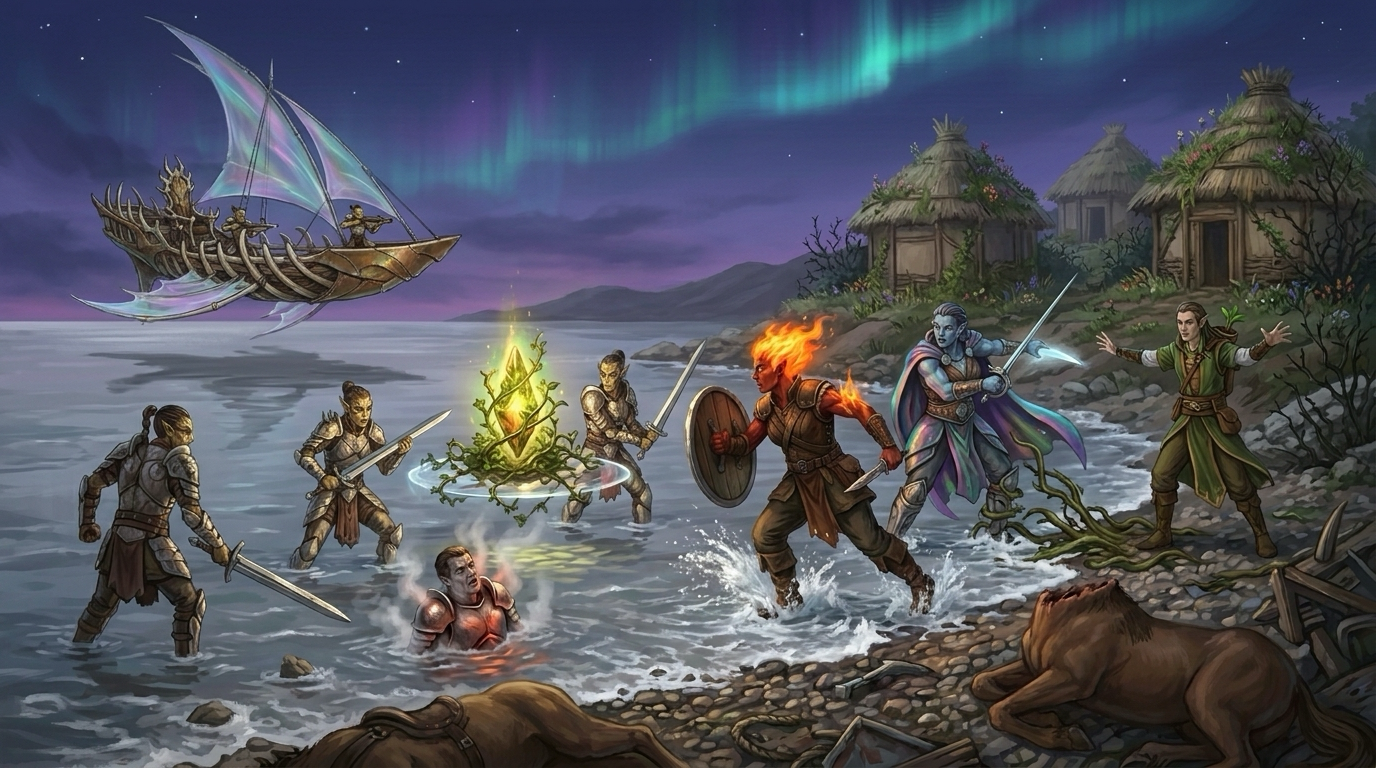
Bramble Bay is a hamlet, in the sense that four round thatched huts above a shingle beach are a hamlet. The blackthorn comes down to the water on either side of it, and the Main oak’s roots come out of the cliff behind it, which is why the Gith chose it.
The fragment had gone through it on its way to the sea. Every roof was alive. Thorn had come up through the thatch and flowered, grass stood out of the roof-ridges, and the whole hamlet looked as if it had been abandoned for a decade rather than an afternoon.
On the stones, the corpses of Erwin‘s centaurs, bloodied and broken.
And at the water’s edge, the Gith, wading out. Their skiff hovered above the shallows a few strides from the shore, waiting for them, and two crossbowmen stood at its rail with the patience of people whose job for the next minute is simply to shoot whatever comes onto the beach.
The Watch came onto the beach.
The handler had got there first. He was in the water up to his waist, still in his armour, with the sea steaming round him and the glow not going out of the steel — the way Veyer had once made a Gith lieutenant’s greatsword too hot to hold, on the deck of the Pale Fang, except that a man can drop a sword. He went under, looking for cold.
Veyer was already in the water after the fragment, rapier out, trading blows with one of the guards round it. She did not turn. But when the handler’s head broke the surface behind her there was a knife in her other hand that had not been there a moment before, translucent, not quite a thing, and she threw it without looking. He went back under. He did not come up again.
The rest of them were nearly at the skiff. Lindon threw the beach at them: every weed and root and strand of thorn between the tideline and the boat stood up at once and took hold, and for one moment the whole column was held fast in the shallows with the glow in the middle of it and the skiff just out of reach.
Then every one of them was gone out of it, and standing further down the beach, deeper in the water, closer to the skiff, with the glow still between them. The Gith blink. Anyone who fought them at the cliffs remembers it. There was no second net to throw, and the skiff was now a few strides away, and the crossbows had not moved.
So Slox ran into the sea.
Straight into the middle of them, shield first, with the bolts on her and the greatswords coming round, and got both arms round the glowing shard.
It took hold of her. Tendrils of ivy and thorn reached out of the light and wrapped themselves round her outstretched arms, winding up to the elbow and drawing tight, and for a long moment nobody on that beach could have told you whether the fragment was being held or doing the holding. She could not have let go if she had wanted to. She did not want to. She turned for the shore.
Then she went up the shingle with it and into the trees, and was gone. The blackthorn at Bramble Bay comes down to the water and has no path through it and never has had. It opened in front of her and closed behind her, and she went through the tangle as easily as walking down a lane. She was carrying a piece of the Green Lord through the Green Lord’s wood, and the wood was not going to be the thing that stopped her.
Lindon was already changing. He came down off the skiff’s wing as a warhorse, all hooves and momentum, onto the nearest Gith, and the Gith went over backwards into the water. Veyer vaulted up as he came past.
They left the Gith standing in the shallows, with their crossbows and their boat and nothing to put in it.
Late
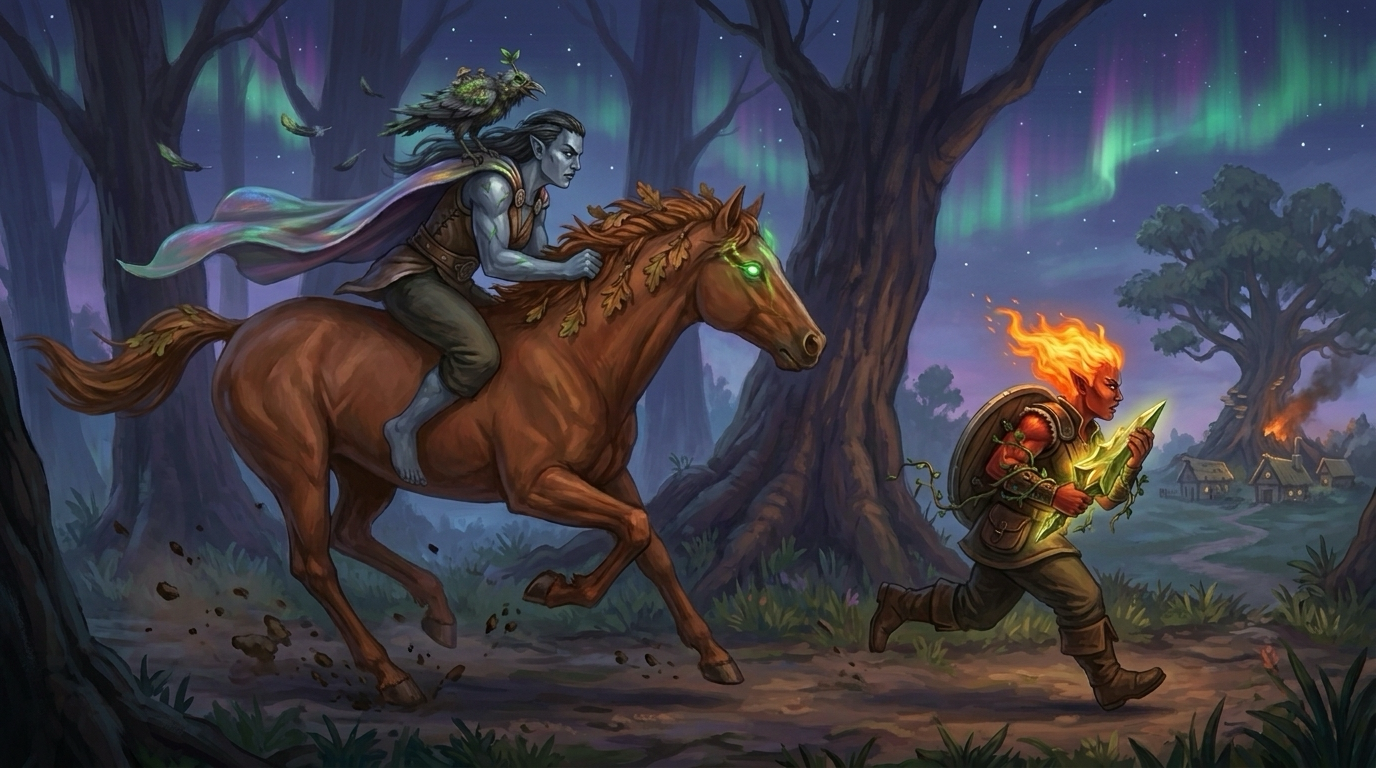
They found Slox on the bay path, still running, the vines still on her arms.
Something came down through the branches at Veyer. A crow, or what had been one: the feathers gone to mould, something green and soft growing in the sockets where its eyes should have been, flying lopsided and with great determination. It landed on her shoulder, put its beak to her ear, and spoke in a voice she knew — from the far side of the shard, from beside a cauldron, kindly, with just a trace of reproach.
“You’re late, dear.”
Then it came apart. The mould took it from the inside out, feathers sloughing, mushrooms pushing up through the breast, and what slid off her shoulder onto the road was not a bird any more but a wet grey heap with a slimy fungus already growing out of it, and spreading as they watched.
They stood a moment in the dusk, three of them and a warhorse, and listened.
It came across the shard on the evening air, faint and a long way off, from the direction of the village. Steel. Voices. A sound rising and falling that nobody who has heard it once ever mistakes for anything else.
The Rite was at dusk, and it was dusk, and the Watch were on the wrong side of the forest with the heart of the shard in their arms.
They ran.


Leave a Reply